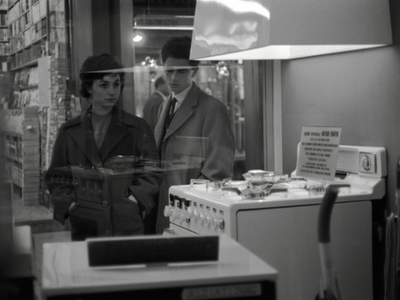
#50: The Heartbreak Kid (Elaine May, 1972)
The Maddening Objectification of an Impossibly Perfect Blonde for Mary, a Carpenters cover for
Steven, Neil Simon for everybody. Don’t lose heart--we’ve only just begun. (Maybe Elaine May behind
the camera is enough to get me a pass on the first transgression.)
The Heartbreak Kid played constantly on TV when I was a teenager--I must have seen it at least 10
times before I headed off to university. It’s a surprisingly key film from a time in my life when
some of my basic attitudes about movies began to take shape: feelings about how music should be
used, a certain kind of mood I gravitated towards (whatever the filmic equivalent of Sunshine Pop
is, that’s the mood I responded most deeply to as a 15-year-old), and a central character who stood
just enough in opposition to “conventional society” (whatever that meant to me at the time) that he
met with my approval. I know, I know--Charles Grodin makes for a very poor Che Guevara. But the way
he bamboozled those fur-loving football players (second clip below) was more than enough for me.
Kael liked it a lot, Kauffmann and Simon, not so much. (Double-checking, I’m surprised to find out
that Simon praised the performances--I figured he’d be especially merciless.) Especially in the
lower reaches of my list, I’ll have a few picks that no one’s going to mistake for art. Like Jeff
says, I’m going to try as much as possible to go with those films that made a lasting impression on
me for one reason or another, allowing the necessary room for more recent favourites where there
hasn’t been enough time for lasting impressions. The Heartbreak Kid clears that bar with room to
spare. And I haven’t even dwelled on the Impossibly Perfect Blonde, the Maddening Objectification
of whom is played off against the (almost cruel at times) reduction to caricature of Jeannie Berlin.
It worked on me. I still hang around oceanside beaches, waiting to hear a disembodied “That’s my
spot” whispered from up above one day.
#49: The Sugarland Express (Steven Spielberg, 1974)
I’m again making my picks as I go along, working from a loose master list of about 75 films. I
decided on The Sugarland Express Thursday night, before Jeff posted his Close Encounters entry.
Thought about switching to something else, but the serendipity must mean something, so I’ll go
ahead as planned.
There are a few Spielberg films where you can legitimately ask, “I wonder how many people have
actually seen this?”--Empire of the Sun, Always, the airport movie--but I’m willing to bet that
The Sugarland Express is still his most underseen great film. If it weren’t for Jaws (which I’ll
probably bypass; the fatigue factor discussed in the music countdown is still operable), I’d say
it’s his greatest film by any yardstick. I know that’s hard to accept if you think his pinnacle
was Schindler’s List or Saving Private Ryan, and it’s probably just as baffling to anyone who
gives that designation to E.T. or Close Encounters.
With Jaws and The Sugarland Express, I feel like I’m watching the work of a runaway talent who’s
still completely immersed in the telling of great stories, without any of the stuff that will
creep into Spielberg’s more ambitious films. I don’t want to start knocking what comes later--I
like Close Encounters a lot, and I understand why the other three benchmarks I’ve mentioned are
famous--but I’m just not as interested in the box-office behemoths (Jaws made a ton of money, but
it wasn’t a preordained event like Spielberg’s other biggest money-makers), in watching Spielberg
work through his various father issues, or especially in Spielberg the Award-Winning Artist. None
of that is even on the horizon in The Sugarland Express (well, there’s maybe a trace of the father
issues): it’s just stunning camerawork from Vilmos Zsigmond, Goldie Hawn’s best performance ever,
a key work in a lineage of New Hollywood outlaw films that runs through Bonnie and Clyde, Easy
Rider, Thieves Like Us, and Dog Day Afternoon (among others), and a 28-year-old prodigy unleashed.
And music, of course--I’ll be guilty throughout this list of giving disproportionate weight to
music in arriving at my picks. John Williams does the score, but it’s Toots Thielmans’ evocative
little harmonica bits that convey the film’s mood best (and capture how much feeling Spielberg has
for the four principals, all of whom inhabit worlds far removed from his own). My favourite moment,
and probably one of my favourite shots in any film: when the screen splits in half horizontally as
Thielmans theme plays at the 35:40 mark, and Hawn and Ben Johnson make eye contact in the front
mirror and smile back at each other.
#48. Nixon (Oliver Stone, 1995)
I was considering Wall Street, an overheated junk bond I’ve seen more times than I care to admit
(powered in part by a drug called Charlie Sheen!), but it occurred to me just two nights ago that
Nixon’s the one--I absolutely have to have Nixon on my list.
I’ll start where Steven left off with Sid and Nancy: I wouldn’t go into this preoccupied with what
you know about Nixon. Getting your head around Anthony Hopkins’ off-putting interpretation is the
first and biggest leap you have to make. He’s not trying for precise mimicry at all--Dan Ackroyd,
Rich Little, etc.--nor is he seizing on one aspect of Nixon’s personality and running wild with it,
the way Philip Baker Hall takes Nixon’s paranoia and elevates it to the nth degree of delirium in
Secret Honor (a more acclaimed Nixon film I don’t like nearly as much). It’s more like Hopkins
spends the whole film tentatively trying to feel his way into the character, always a half-beat
off, never quite sure which Nixon he’s supposed to be at any given moment. Which is, of course,
perfect; Nixon himself spent the entirety of his public career groping around for some semblance
of an authentic self, and he seemed no less awkward or embarrassed inside his own skin than Hopkins
does. It’s a weird, heavy (literally; Hopkins is always lurching around with his shoulders slumped),
but ultimately affecting performance.
Factually--well, it’s Oliver Stone. As with JFK, he conflates, reshuffles, and creates “counter-
myths” (a favourite Stone word) whenever it suits his purposes to do so. There are probably a thou-
sand little fibs scattered throughout Nixon, and, to me, it wouldn’t be very interesting to start
cataloguing them. Here’s one big one: the idea that RFK’s assassination was the trigger that led
Nixon to seek the presidency in ’68. If you’re at all familiar with the actual timeline, that’s
laughable; Nixon had decided as early as the impending Goldwater debacle in ’64 that he’d be the
guy to pick up the pieces, and I wouldn’t even doubt that he started thinking about running within
five minutes of finishing his infamous concession speech in ’62. That’s a more serious transgression,
because it misrepresents something fundamental about Nixon’s character.
Even that doesn’t matter, though. Stone gets the story right in broad outline, and he also gets at
something much harder to pin down. Here’s how Greil Marcus describes the experience of watching
the film in an essay on J.T. Walsh included in O.K. You Mugs (Walsh plays Ehrlichman): “One night,
though, flipping channels after the late news had closed down, I happened onto Nixon running on HBO,
and I didn’t turn it off. I was pulled in, played like a fish through all the fictions and flash-
backs, dreaming the movie’s dream: waiting for Watergate.” “Dreaming the movie’s dream”--I love that
line. There’s something very sad and very majestic about Nixon (a nod to John Williams’ score on that
front), and even if you despise Nixon as much as most people who’ll take the time to seek out the
film almost certainly do, I think you end up feeling the weight of the man and the full scope of his
centrality to post-war America; like Neil Young’s “Campaigner,” it takes you to a place where you can
say, “Okay--there was a life there.” Everything ends, as it should, with footage of Clinton’s eulogy
in 1994. It’s a movie I expect I’ll be revisiting once every year or two for the rest of my life.
#47: Hud (Martin Ritt, 1963)
This coming Monday, I’m going to see Richard Corliss introduce Lolita. (He was a last-minute re-
placement for David Thomson.) I haven’t read Corliss in years, but the one thing I remember about
him is that, sometime in the early ‘80s, he tried to counter Sarris’s book with a theory that
screenwriters were at least the equal of directors as Hollywood’s truest auteurs.
I don’t necessarily subscribe to that--I haven’t really thought about the issue enough to have
any kind of an informed opinion--but Hud is an excellent test case for how you apportion a film’s
authorship. Who should get the most credit here: director Martin Ritt? Larry McMurtry, who wrote
the novel (though not the screenplay, which belongs to Irving Ravetch and Harriet Frank, Jr.)?
Cinematographer James Wong Howe? (He also shot Sweet Smell of Success.)
Most people who love Hud probably don’t think of any of those names; it’s Paul Newman’s film from
start to finish. Newman’s great, and clearly having great fun playing, depending upon how you view
him, a cruelly pragmatic realist/unmitigated piece of slime, but he shouldn’t even get credit for
the best performance; Patricia Neal gives what might be my favourite female performance in any film.
I couldn’t find a good short clip of her, so here’s “Part 10” in its entirety. Watch her starting
at the 7:00 minute mark, one of the greatest leavin’ scenes I can think of. “Far as I can get on a
bus ticket...”--perfect. (For what it’s worth, I think Melvyn Douglas and Brandon de Wilde are fine
too. They get knocked for various reasons, and I’ll concede that old Homer’s self-righteousness is
a bit much at times, but they have a number of great moments between them.)
Surprisingly (to me, anyway), Hud doesn’t have much critical cachet--I don’t know that I’ve ever
seen it draw a single vote in the annual Sight and Sound greatest-ever polls. Sarris’s American
Cinema has had a lasting influence on me, and even though I’m a much bigger Kael fan, it’s a book
that did a lot of good. But also some harm, and I’ll lay Hud’s neglect at Sarris’s feet. Because
Ritt was written out (Ritten out?) of the auteurist hierarchy, Hud got pushed aside too. I mean,
it’s still famous, on account of Newman and O’Neal, but I don’t think it gets nearly enough crit-
ical attention for how great a film it is overall. For every word ever written about Hud, I bet
there’ve been 1,000 words spilled on 1963’s big auteur favourite, The Birds. And I think that’s
wildly off the mark.
#46. Il Posto (Ermanno Olmi, 1961)
If nothing else, this one gets in on the Neil Young Rule: “I fell in love with the actress/She
was playing a part that I could understand.” The stuff about playing a part that you can under-
stand isn’t even all that important.
My list will be woefully short on non-English language films. I’m guessing two or three; another
10 would be in my second tier of favourites--a Top 150, maybe--but there just aren’t that many
that have ever hit me with the force that my American favourites from the ‘60s and ‘70s did. The
number of silent films on my list will be even more pathetic: zero. For a guy with a film degree,
I make a very poor cinephile.
I’ve seen Il Posto three times now--most recently a week ago, when I rented it out, which is why
I want to comment on it while it’s still fresh in my mind--and I’m confident that it belongs here.
Steven gave it a very middling write-up in his weekly round-up a few months ago, and while I can’t
say I sharply disagree with anything he said, I love some of the very same things that left him
cold. He wrote that the story never really goes anywhere; it may in fact be somewhat generous to
credit Il Posto with a story at all. (Plot summary, more or less: teenage boy applies for an office
job, hangs around for a few hours with another girl who has applied, both are hired, boy goes to
company Christmas party, girl doesn’t show, next day at work, the end.) Sometimes I respond to such
minimal narratives, sometimes I’m bored silly--Il Posto is one where I respond. Steven mentioned
Sandro Panseri’s “big dark eyes,” and said they hint at something deeper than the otherwise blank
expression he wears throughout the film; for me, the combination is richly expressive--of uncer-
tainty, of loneliness, maybe even of a deep sadness, although there doesn’t seem to be any particu-
lar reason he’d be so sad at such a young age. Steven also made note of how the ending suggests “a
lifetime of alienation,” but didn’t seem particularly convinced that the film went any deeper than
the suggestion. I think Il Posto’s final shot sets up the life-of-quiet-desperation thing as com-
pletely and as depressingly as any movie I know. (The film appeared around the same time as Billy
Wilder’s The Apartment, and both seem to come out of the Man in the Gray Flannel Suit anxiety of
the mid-‘50s.)
I’ve used Steven’s write-up to set my own--see Il Posto, and you may well find yourself just as
indifferent and unmoved as he was. Steven didn’t mention Loredana Detto, the girl who catches Pan-
seri’s eye as he waits to be interviewed. They go for coffee afterwards in the clip below (sorry,
no subtitles). I didn’t know she was also Olmi’s wife until I went looking for some information
about her. She’s part of my own life now, having replaced Nico in The Chelsea Girls as my new
screen-saver.
#45: Smoke (Wayne Wang, 1995)
Just like it did with the music countdown, what I’m able to find on YouTube will occasionally tip
the scales as to what sneaks onto my list, especially early on. If I can find exactly the one scene
that I’d most want to share from a film, that’s a big plus.
In the clip below, cigar store proprietor Harvey Keitel discusses his “life’s work” with widowed
writer William Hurt. Keitel refers to his hobby as a “project”--those who followed the music count-
down will know that that word has special resonance for me. Hurt is perplexed at first--a bit of a
stretch, actually; as a successful writer, I would have thought he’d intuitively understand the sub-
tleties of Keitel’s project--then amused, and then, in a turn that caught me completely by surprise
the first time, shattered. It’s an amazing scene, one that encapsulates the mood and small perfec-
tions of Wang Wang’s underseen film.
One thing that has always bothered me is the idea that seriousness, high purpose, and artistic value
are automatically conferred on a film via subtitles. This was common back in university, and I’ve
also encountered it in critics and in friends. It’s a point I’ve lightened up on over the years--I
used to be much more judgemental (and much more blinkered) than I am now. Smoke is an art film in
the very best sense of what that might mean, with the qualities and the pacing that are associated
with the best of Truffaut, Rohmer, or Ozu. (As opposed to the very worst sense; there’s no shortage
of arty American films.) I’m sure that has something to do with Wang having been born in China, and
not having come to America until he was 17, but the why of it is a separate issue. The fact is, Smoke
came and went with not a lot of fanfare. And I wonder if it would have been more written about, and
more remembered today, if it had come from France or Taiwan. Hou Hsiao-Hsien, Abbas Kiarostami, and
Apichatpong Weerasethakul (to name three examples out of many) are staples at Toronto’s Cinematheque,
and that’s great, I’m grateful that I can see their films. Smoke has played there maybe once in 15
years, if that.
Gregory Peck’s Atticus Finch once won an AFI poll for the most heroic character in any American film.
Keitel’s Auggie Wren would be my nomination for the most heroic character of the past however-many
years. He does two different things in Smoke--or rather, he does one thing and doesn’t do something
else--that I find tremendously moving. I just love the guy.
#44: Heart Like a Wheel (Jonathan Kaplan, 1983)
Although a reasonably high-profile film the year of its release--Bonnie Bedelia got a Golden Globe
nomination for her portrayal of race-car driver Shirley Muldowney, and she should have been up for
an Academy Award, too--it’s since slipped into obscurity. Like The Heartbreak Kid, all the DVD
copies on Amazon are ridiculously overpriced ($60+ for the “Special NHRA Edition”), which presumably
means it’s out of print, and finding a decent YouTube clip wasn’t easy. I’ve got a VHS copy, which
is appropriate--it feels like a VHS movie.
Surprisingly few films have the ability to make me tear up, but Heart Like a Wheel does that to me
every time, and not just once. First there’s the scene where Shirley’s ex-husband calls her out of
the blue for the first time in years, and I again turn to mush when Shirley throws herself into the
arms of her arch-nemesis Connie Kelita after winning the film’s climactic race (bizarrely preempted
in the YouTube clip). If there’s a hypothetical midpoint somewhere between Roger Corman’s Eat My Dust
and one of those small Czechoslovakian art films from the mid-‘60s, that’s where Heart Like a Wheel
exists. (By the way, I haven’t seen either Eat My Dust or any of those small Czechoslovakian art
films--like I say, hypothetical.)
I’ve written about Heart Like a Wheel’s use of pop music before. The title song doesn’t appear any-
where in the film, but you get the Flamingos’ “I Only Have Eyes for You,” “Turn, Turn, Turn,” “Happy
Together,” and two or three other period songs. The way Kaplan uses “Happy Together” is right up
there with my favourite Scorsese, P.T. Anderson, and Tarantino sequences. I also love how Beau Brid-
ges’ performance as Kalita is the mirror image of his excellent performance in The Fabulous Baker
Boys. There, he was the stodgy family man; here, he gets to step in for his brother Jeff and play
the womanizing cad. I can’t say enough good things about him, Bedelia, Leo Rossi, or Hoyt Axton.
Heart Like a Wheel did get one Academy Award nomination, for costume design. I haven’t a clue why--
racing gear to me looks like leftover spacesuits from the Plan 9 shoot.
#43: Barry Lyndon (Stanley Kubrick, 1975)
I indicated to Steven and Jeff early on that I was surprised by one of the films I was considering.
This is it. Two years ago, I wouldn’t have been able to conceive of Barry Lyndon being on a list of
my favourites; ten years ago, I still hadn’t even seen it. I want to get it on here early, otherwise
I’ll wait too long and talk myself out of it.
Just before Eyes Wide Shut came out, I wrote a round-up of Kubrick’s films for Andrew Palmer, an
editor I knew in New Zealand. I mentioned in the piece that Barry Lyndon was one of three Kubrick
films I’d never seen, and that I was holding out on Barry until it turned up somewhere in Toronto on
a big screen. (I'm down to just one: Fear and Desire.) A few more years passed before that finally
happened, and on first viewing, I don’t think I quite knew what to make of it. The first thing that
threw me (and simultaneously fascinated me) is what I’ll call the John Wesley Harding disconnect,
named in honour of the album where Dylan seemed to be operating in some universe parallel to the one
where the Vietnam war, assassinations, rioting, and various other kind of madness were dominating
the news of the day. Barry Lyndon similarly appeared on the heels of Watergate, Nixon’s resignation,
Patty Hearst, gas shortages, etc., surrounded on all sides by the likes of Chinatown, Godfather II,
Nashville, Dog Day Afternoon, Shampoo, Smile, Night Moves, Welfare, Taxi Driver, and other like-
minded ruminations on America’s decade-long decline and fall. Kubrick’s response to the crumbling
landscape? A stately, baroque costume drama about upward mobility and social humiliation in 19th-
century England. Of course, as Jon Landau famously wrote about JWH, to disengage so completely
becomes a statement unto itself. (That’s not really what he wrote...I’m paraphrasing liberally.)
Take away Barry Lyndon’s soundtrack, and it wouldn’t be here. The accompanying clip is a perfect
example. What gets said is so minimal, and of such little consequence, that I’m able to use a clip
that’s been dubbed into another language. All that matters is the Schubert piece on the soundtrack,
the dreamy languor, Marisa Berenson’s beauty, and the texture of the light (a celebrated advance in
technology whereby Kubrick was able to shoot scenes by candlelight). Elsewhere, there’s Bach, Vival-
di, Handel, and some beautiful interludes from the Chieftains. Stuff happens in Barry Lyndon, and
some of it is very moving--the death of Barry’s youngest son, Barry’s sad reduction to a pitiable
cipher by film’s end--but for me, it’s ultimately the music that holds everything together and (I’ve
seen it three times now) stays with me for days afterwards. That, and the film’s epilogue, a single
title card: “It was in the reign of George III that the aforesaid personages lived and quarrelled;
good or bad, handsome or ugly, rich or poor, they are all equal now.”
#42: Invasion of the Body Snatchers (Philip Kaufman, 1978)
By 1978, I think it’s fair to say that American movies were coming out the other side of a legend-
ary period that started around ’71 or ’72 and culminated in ’76. 1978 was the first post-Star War
year, and the blockbuster business model that is still in place today really started to take hold.
Hollywood must have made some ungodly amount of money that year: Close Encounters (listed by Jeff
earlier), Saturday Night Fever and Grease, Superman, Animal House...That’s a lot of box-office--I
checked, and even the year’s two big Vietnam films, Coming Home and The Deer Hunter (with a third
on its way), are listed among 1978’s 20 biggest money-makers. I love a couple of those films, and
like all of them to one degree or another. It’s not that there weren’t still really good films being
made. There just weren’t as many of them as there were three or four years earlier, and something
tangible had changed.
What does all that have to do with Invasion of the Body Snatchers? I don’t know--I needed an intro!
I suppose Invasion has a foot on both sides of the divide. It has the feel of one of those pantheon
Altman films that turned genre on its head and definitively captured that early-‘70s era--it is to
science-fiction what The Long Goodbye was to the classic detective film--but I also suspect the
studio had hopes that it would take off commercially in a big way. It did pretty well ($25M, still
a lot in ’78). I think it was maybe ultimately just a little too flaky to do any better.
We were playing Invasion at the Georgetown Theatre the year I worked there as an usher in grade 13.
I’d watch it over and over, and for a time I could rhyme off long sections of dialogue whole. It’s
a film that works on at least three different distinct levels. Needless to say, it’s really scary.
The first clip below is the famous ending. Do with it what you will; if you’ve managed to live this
long without having seen Invasion, obviously my advice is to skip that clip. It’s also a great
romance, as witness the second clip, the scene that made many of us fall in love with Brooke Adams.
And while I won’t try to argue that Kaufman’s remake has the political immediacy of the 1956 ori-
ginal, an ingenious re-imagining of McCarthyism, there is subtext. I think Kael (who rhapsodized
about the film) wrote that Leonard Nimoy’s Dr. Kibner was a spoof of all those ‘70s self-help
gurus who invented programs like EST, and that in general Kaufman was having fun with right-wing
America’s worst fears about San Francisco. Sounds reasonable to me--maybe Steven can chime in on
that.
The five principal performers--yes, including Nimoy--are excellent. Jeff Goldblum does Goldblum
schtick before it had become schtick; I like him here just as much as I do in The Fly. Donald
Sutherland’s sleepy-eyed perfect (again, think of Gould in The Long Goodbye), and you wonder why
Veronica Cartwright didn’t go on to win a shelf’s worth of Academy Awards. Best cameo ever: Kevin
McCarthy, star of the original, still madly running around 22 years later trying to alert the
world to impending doom. And keep an eye out for Robert Duvall and Don Siegel, too.
#41: The Straight Story (David Lynch, 1999)
If it weren’t for three films--well, two films and a TV project--the career of David Lynch would
be pretty much without interest for me. Mulholland Dr. and Inland Empire are my two personal bete
noires, and I jump on the message board every chance I get to assail them with derision. The former
was so universally acclaimed, and topped so many decade-end polls, I’m willing to grant that there’s
something there I’m just not getting; God himself could declare Inland Empire a work of genius, and
I’d still roll my eyes. Most everything else Lynch has done goes right past me, Eraserhead included.
I’ll give a pass to The Elephant Man--I know Scott loves that one, and I probably need to watch it
a second time.
So what do I like? On one hand, the two most obvious candidates--Blue Velvet and Twin Peaks--and on
the other, the least obvious, which would be this. I can’t think of a more anomalous movie in any-
one’s filmography than The Straight Story within Lynch’s. It’s not just a departure, the way some-
thing like The Age of Innocence was for Scorsese; on closer inspection, such departures often turn
out to be a director’s signature film in disguise, with the same themes and the same stylistic
flourishes. And maybe someone else could make the same case for The Straight Story. I couldn’t--I
find it as disconnected from Blue Velvet as Neil Young’s Trans was from Everybody Knows This Is
Nowhere. (But a disconnect in the right direction with Lynch.)
The Straight Story is surely one of the best films ever made about getting old, deserving of a
privileged place alongside Wild Strawberries, Tokyo Story, The Leopard, and a few others that
always get listed at the front of that line. Among brother films, it’s up there with On the Water-
front and Raging Bull. It’s one of my favourite road movies ever; here, the road goes by very,
very slowly. It’s a work of such subtlety and such feeling, and so completely* free of all the
stream-of-consciousness weirdness that marks Lynch’s career--a weirdness that is sometimes stun-
ning, but more often forced and juvenile--that I’m not at all surprised it seems to be little
more than a footnote among Lynch’s cult. On one of the threads devoted to him on the message
board, a couple of people list their Lynch Top 10s: one puts The Straight Story 7th, the other
has it 9th. (A few posters do praise it.) My default Lynch putdown is an ominous voiceover on
a trailer announcing, “Coming soon, from the mind of David Lynch...” You wouldn’t find that
voiceover on any trailer for The Straight Story.
This was Richard Farnsworth’s last film; he died a little less than a year after its release.
I’ve been meaning to see The Grey Fox for years, but just haven’t gotten around to it. Ending
your career with The Straight Story is like Sandy Koufax in 1966, or the Velvet Underground with
Loaded. As for the plot...Farnsworth plays a guy who travels across four or five states on a
tractor to visit his estranged brother. It takes a while, and things happen along the way.
*(Not completely true: there’s a roadside scene with a distraught woman that feels like it was
parachuted in from some other Lynch film--for me, the movie’s only misstep.)
#40: The China Syndrome (James Bridges, 1979)
The day the world turned day-glo. (Almost.)
There was a film a few years ago that had the good fortune to get its release just before a big
news story broke directly related to what the movie was about. Maybe somebody knows which film I
mean--for some reason, I’m blanking out. Anyway, I remember thinking at the time that it was the
luckiest film since The China Syndrome, the most famous example of such serendipitous timing. And
The China Syndrome’s serendipity score was off the chart: it was released on March 16, 1979, and
12 days later Three Mile Island started leaking nuclear reactant coolant. Looking at the Wikipedia
page for Three Mile Island, the parallels between movie and real-life event are even more astound-
ing than I realized:
The mechanical failures were compounded by the initial failure of plant operators to recognize the
situation as a loss-of-coolant accident...in particular, a hidden indicator light led to an operator
manually overriding the automatic emergency cooling system of the reactor because the operator mis-
takenly believed that there was too much coolant water present in the reactor and causing the steam
pressure release.
Exactly like in the fictional version: a little red needle on a valve meter gets stuck, and every-
body does the precise opposite of what they should be doing.
The ‘70s was a great decade for movie paranoia: Jeff had Marathon Man earlier, and this is the
first of three or four films I’ll be listing that mine similar territory. J. Hoberman’s The Dream
Life documents this era very well, stretching from The Manchurian Candidate in ’62 to De Palma’s
Blow Out 20 years later. The China Syndrome is not usually cited at the forefront of the genre--I
think something of a gimmicky reputation has attached to it because of its backstory--but it was
reviewed very well in its day, and I get as caught up in it as ever when I revisit it every couple
of years.
Thoughts on the two lead performances...Kael, a big fan of Jane Fonda’s work in Klute, hated the
way she was softened and dumbed-down for both this and Coming Home. I can understand that; I remem-
ber having the same problem with Sam Jackson in Changing Lanes, insofar as I’m not eager to watch
Jackson in anything where he’s not saying “motherfucker” every fifth word. (Ditto Joe Pesci.) But
if you can get past that, and accept Fonda’s character on its own terms, I think she’s great. As
for Jack Lemmon, I’ve come to believe that he created the template for Nicholson, De Niro, Pacino,
Hoffman, etc.: early brilliance giving way to an inventory of tics and mannerisms that often make
him unwatchable in later years. But every now and again, you’d get a reminder of what an amazing
actor he could be. I’d put forth The China Syndrome as one of those reminders, although I can see
where someone else might see the same old tics and mannerisms. Kevin Spacey addresses all of that
in the second clip below; the first is just about the most exciting eight minutes in any thriller
I can think of.
Incidentally, yesterday was the 25th anniversary of Chernobyl.
#39: North Dallas Forty (Ted Kotcheff, 1979)
I’m sticking with the musicals. This one has some music--Chic’s “Good Times,” to be precise.
A baseball fan for as long as I can remember, I dislike baseball films almost without exception;
football I haven’t paid attention to since the days of Roger Staubach and Lynn Swann, but my favour-
ite sports film is about football. (Favourite non-documentary sports film, anyway--and that may even
be true if you count Raging Bull as a sports movie.) North Dallas Forty came out the summer after I
finished high school, a point in my life where my feelings about sports--playing sports, as opposed
to fandom--were at their most jaundiced ever. All thanks to my high school basketball coach there.
So the timing was perfect: Kotcheff’s film (I haven’t read Peter Gent’s novel) gave voice to those
feelings almost as witheringly as Jim Bouton’s Ball Four, which I had discovered a year or two
earlier, and watching Nick Nolte and Mac Davis flash “Can you believe this nonsense?” looks at each
other during team meetings was pretty much the story of my high school basketball career, such as it
was.
The accompanying clip is a mish-mash of various scenes from the film, some of them key. I love John
Matuszak going off on Charles Durning’s weasly assistant coach at the 4:00 mark: “Every time I call
it a game, you call it a business, and every time I call it a business, you call it a game.” Most
of the final scene is included, where Nolte gets hauled before management on a trumped-up charge
meant to corner him into quitting. Which he does, after delivering the film’s key line: “We’re not
the team--they’re [motions towards management] the team.” A lot of North Dallas Forty makes more
sense in the context of a pre-free agency world, when management still held the upper hand and pro-
fessional athletes were basically cattle to be bought and sold on a whim. Baseball was a few years
into that system being overturned by 1979; I’m not sure, but I think football was slower to change.
In the world of LeBron James and Alex Rodriguez, Matuszak’s speech and Nolte’s righteous outrage
seem quaint. But I’m enough of a fan to believe that there’s still fundamental truth in some of what
they say.
Nolte, Davis, G.D. Spradlin, Dabney Coleman, a bunch of people in smaller roles, they’re all ter-
rific. Spradlin especially interests me: between this, Senator Geary in Godfather II, and his
spooky military guy in Apocalypse Now, I count him as one of the decade’s great forgotten support-
ing players. I’m not putting forth North Dallas Forty as film art. Visually, it’s nothing to look
it--it’s probably interchangeable with Firepower, Force 10 from Navarone, and all the other crummy
late-‘70s fare that played at my theatre--and there’s one terrible performance from Dayle Haddon.
But it’s a movie that appeared as manna to me in 1979--I felt like I too had just finished putting
away childish things--and I love it to this day.
#38: Casualties of War (Brian De Palma, 1989)
One war film only. I considered Paths of Glory, but one Kubrick is enough. The Deer Hunter and
Apocalypse Now (and, to a lesser extent, Coming Home) had a huge impact on me as a teenager, but,
not surprisingly, that has waned over time. I still think The Deer Hunter has remarkable passages,
and also some juvenile sentiment that dates badly; Coming Home has problems too, balanced by some
very moving scenes. (I recently called it the opposite of Joe Rudi: Rudi was an overrated underrated
baseball player, Coming Home’s an underrated overrated film.) Apocalypse Now...is famous.
So: Casualties of War. The last few years of Kael’s tenure, I don’t think I was on the same page as
her. She seemed to gravitate to stuff like Scrooge, Club Paradise, Dirty Rotten Scoundrels, films I
wasn’t even remotely interested in, while Stranger Than Paradise, sex, lies & videotape, Miller’s
Crossing, and others were either bypassed or, at best, accorded qualified, disinterested praise. It
felt at times as if the more a film aspired to, the more seriously it took itself, the less chance
it had with her. That’s a simplification, of course, and it’s also a tendency that had been part of
her writing forever. I just felt like it became magnified towards the end. But with Casualties of
War, she nailed it. I don’t know if it was her last epic review in the style of her reviews for Last
Tango and Nashville--Enemies: A Love Story was in there too, and I’m too lazy to check which came
first right now--but it’s the one that I prefer to think of as her equivalent of Ted Williams’ final
home run. Casualties got lost in the late-‘80s spate of Vietnam films--Platoon, Full Metal Jacket,
Born on the Fourth of July, Good Morning Vietnam, two or three others--and in 1989, it probably
didn’t get 10% of the attention that Do the Right Thing did (which I like fine). Kael is the only
critic I remember who was alert to how masterful it was, and she took that and ran with it like it
was 1975.
The few war films I like tend to have relatively few combat sequences--not sequences in the field,
but actual combat--and that’s true of Casualties. The scene I’ve linked to is representative of much
of the movie: one prolonged game of mental chicken between Sean Penn’s Sgt. Meserve and Michael J.
Fox’s Private Eriksson, triggered by the abduction and then gang-rape of a Vietnamese peasant girl.
A story I’ve told before: there was a local critic (now a very prominent higher-up in the Toronto
Film Festival) who dismissed Casualties at the time by saying it was another De Palma “kill the
bitch” film. Twenty years later, I still count that as the single stupidest line of film criticism
I’ve ever read. (Sorry--I considered “most irresponsible,” but “stupidest” is a better fit.) De
Palma’s treatment of the girl is humane and shattering beyond words.
There are a couple of missteps, especially a scene where Fox needlessly and clumsily starts musing
aloud about stuff we can figure out for ourselves (his “maybe it matters more” monologue). And Penn
gives a highly stylized performance that you may recoil from--the clip will be a good test of that.
Otherwise, pretty close to perfection I’d say. Last word to Kael:
“(Some movies) have more imagination, more poetry, more intensity than the usual fare; they have
large themes, and a vision. They can leave us feeling simultaneously elated and wiped out...Casual-
ties of War has this kind of purity.”
No, last word to me. 1) Her Enemies review appeared a few months later; 2) I may have two more De
Palma films on my list--not sure yet; 3) great soundtrack, a tiny bit of which appears at the end
of the clip.
#37: Lost in America (Albert Brooks, 1985)
This is a very strange thing for a movie fan to admit: I almost never go to see comedies anymore.
Maybe one every couple of years. I saw Wedding Crashers, and I don’t quite remember why--I’m think-
ing I must have seen it with somebody else who wanted to see it more than I did. (It may have even
been the last film I ever saw with my mom.) I’ll very occasionally watch one at home that I found in
a sale bin, like Anchorman or Observe and Report. Those exceptions noted, the entire Judd Apatow/Will
Ferrell/Zach Galifianakis/Seth Rogen era has passed me by.
I laugh all the time at the movies, of course, but the comedy is integrated into films that aren’t
conceived or marketed as “comedies”; Lost in Translation would be an obvious example among many. And
in real life (irl on the message board, acronym #37 that makes me roll my eyes--did you really save
all that much time?), I joke around too much. Sometimes I don’t know where to draw the line. (Hi,
Jenn!)
Lost in America may join The Heartbreak Kid as the only comedy on my list. Again, it’s a blurry line;
there’s lots that makes me laugh all through my list, but there aren’t really any comedies. Lost in
America may not even qualify--clearly, Albert Brooks has much more in mind than just making you
laugh, although its connection to a specific historical moment that has faded from view, the advent
of yuppiedom, may undermine its larger themes. In any event, there are scenes in Lost in America--
the nest egg speech, the crossing-guard interview (see clip), Brooks grovelling to Gary Marshall’s
casino owner (“The Desert Inn has heart! The Desert Inn has heart!”) that bring me to tears I laugh
so hard. Sometimes it’s just a random line, like when Julie Hagerty (who might be the best reason to
see the film) asks Brooks why he’s treating her like a dog: “I’ll tell you later.” I can’t imagine
that losing the context of yuppiedom would make any of that less funny to someone seeing the film
for the first time.
Lost in America was Brooks’ third film as a director: the first two attracted a fair amount of
attention, and at the time, I’d say he seemed almost as important as Woody Allen. He never quite
followed through, though. I thought Defending Your Life was pretty good, especially Meryl Streep’s
performance, but I didn’t like Mother, and the two after that were very slight. He hasn’t made a
film since 2005; he seems to do very well in other people’s films. He’ll be on my list two more
times.
#36: The Apartment (Billy Wilder, 1960)
Again: is this a comedy? I don’t know. I love it, I’ve seen it numerous times, and I hardly laugh
at all. It’s a great romance, and it has something of an epic feel to it--indeed, at 125 minutes,
it has a running time more associated with weighty historical dramas. It’s right there with Roman
Holiday and Breakfast at Tiffany’s as my favourite romance. (Casablanca, not even close.) I think
I’ll only have room for one of them, though, so this is it.
Just like Lost in America, The Apartment satirizes a breed of corporate climber associated with a
specific moment in time. I mentioned that moment in my Il Posto comment earlier--Wilder’s film is
the American flipside of Olmi’s, with existential despair giving way to American ingenuity at its
crassest. The Il Posto kid confronts the soul-crushing machinery of corporations by staring soulful-
ly into the void; Jack Lemmon instead sees opportunity and gets busy--until, in time, he ends up
somewhere closer to the Il Posto kid. The two films would make a great pairing, double-bill-wise.
This is the rare case where I think Academy Award voters were ahead of critics. The critical stand-
ing of The Apartment has risen significantly over the years: it presently sits at #58 on the They
Shoot Pictures, Don’t They? list, still below Psycho (#32) but a lot closer today than it would
have been 25 years ago. Said voters were out to lunch when it came to Psycho, mind you, which I bet
didn’t even come close to a best-picture nomination. If that seems confusing...while the critics of
the day obviously did like The Apartment (I just checked, and it was also named best film by the
New York Film Critics Circle), I still think it was a surprisingly great and forward-looking Best
Picture choice. I would have expected Spartacus or Elmer Gantry or The Sundowners, any one of which
seems like a more typical winner circa 1960.
I talked about Lemmon earlier. Having grown up on My Three Sons, I was amazed later in life to dis-
cover the other Fred MacMurray, the dark and creepy guy from two of my favourite films ever. (Not
difficult to figure out the other.) I can’t even imagine what the movie careers of Chip and Ernie
were like. Also worth making note of in The Apartment: Ray Walston, from My Favorite Martian and
Fast Times at Ridgemont High, and David White, the only person from Bewitched who’ll make my list
twice. (Aunt Clara checks in once.) And of course, Shirley MacLaine as Miss Kubelik...big sigh. The
clip below is probably my favourite scene: “You tell them, now and then.”
Final thought: no one can match Billy Wilder in the last-line department. Sunset Boulevard, Some
Like It Hot, and The Apartment have three of the most famous ever.
#35: Jackie Brown (Quentin Tarantino, 1997)
Steven mentioned this in passing in one of the comments threads (The Straight Story?). I knew I’d
be listing it, so I didn’t jump in.
I’m surprised to see that I didn’t have this on a decade-end list I put together for Scott’s old
Popped site (link below); I didn’t even have it among my 10 runners-up. I liked it a bunch right
from the get-go, so that doesn’t totally make sense to me...except I see that no director is listed
twice, and I had Reservoir Dogs at #6, so I must have been working under a self-imposed one-film-
per-director rule. I won’t be following that for this list.
Jackie Brown took over as my favourite Tarantino film a few years ago. I still think Reservoir Dogs
is great, but it’s all sensation, and such films can sometimes lose something over the years. I
haven’t budged on Pulp Fiction since I wrote a long thing about it for Martina Eddy’s fanzine just
after it came out: great for the first 30 or 40 minutes, then it dies during the Christopher Walken
flashback and never really finds its footing again until the last scene. I don’t have anything posi-
tive to say about his output since Jackie Brown. I bought a used copy of Inglourious Basterds months
ago, just so the used copy of Shutter Island I bought around the same time would have some company
in the I-just-can’t-bring-myself-to-watch-this pile.
I’ve only re-watched a few of the films I’ve listed so far, but I took another look at Jackie Brown
last night. I still don’t understand the intricacies of “the exchange” engineered by Jackie. What I
mean is, I understand the concept of the double-switch in broad outline, but not how Jackie plays
the ATF guys against Sam Jackson with two different versions of how everything will transpire, allow-
ing her and Robert Forster to sneak in a third version that ends with the half-million in their hands.
With a little effort, I’m sure it’s not all that complicated to figure out. There’s so much else in
Jackie Brown, I’ve never felt the need to make that effort.
For one thing, it’s another great film (like The Straight Story) about getting old. It reminds me
of “Eleanor Rigby” that way; there was no reason in the world why the Beatles, as 20-somethings at
the apex of their worldwide celebrity and pop-star glamour, would duck out for a minute to write a
heavily-orchestrated song about lonely anonymous people, just as it was unexpected (for me, anyway)
that Tarantino, a 30-something director at the apex of his Sundance cool and kiss-kiss-bang-bang
pyrotechnics, would suddenly have scenes where Pam Grier and Forster compare notes on aging. The
pyrotechnics are still there in Jackie, but it’s primarily a love story between a couple of weather-
beaten 40-somethings (actually, Forster’s character is more likely in his 50s).
It’s Grier and Forster’s film, but the truth is that I keep going back for Sam Jackson. His Ordell
Robbie is a motormouth spinning off invective in every direction, but Jackson’s even better when he
pulls back. I’m thinking of the terrifying expression on his face as he sits in the car while Johnny
Cash’s “Tennessee Stud” plays, or his reaction to Forster’s line about white guilt: “Oh, it’s like
that, huh?” Based on this, Pulp Fiction, and Jungle Fever alone, he’s my favourite actor of the past
quarter-century.
#34: Straight Time (Ulu Grosbard, 1978)
’77 and ’78 was right around the time when my interest in film started to deepen--or, more pre-
cisely, when certain movies started to affect me more than movies had ever affected me previously.
I was 17 in ’78, so my timeline won’t match everybody’s; I think for many people, the most formative
movie experiences of your life happen earlier, sometimes much earlier. I still have a vague memory
of Straight Time being in theatres, and I remember that it looked like something I’d want to see.
I’m going to guess that at that point in my life, I would have seen All the President’s Men and Lenny
at the drive-in with my parents, and possibly The Graduate on TV. Don’t think I yet knew who Pauline
Kael was, so I wouldn’t have known that she called Dustin Hoffman’s performance in Straight Time
“daring, stretching, self-testing.” That was an aside in her review of Agatha a year later; she
didn’t actually review Ulu Grosbard’s film until 5001 Nights at the Movies, where she said “Hoffman
gives what is possibly his finest (and most demanding) performance.” In any event, it would be 20
years or so until I finally caught up with Straight Time myself. I’m not sure why there was such a
gap between taking an interest in the film and actually seeing it.
Performances aside, Kael didn’t seem to think much of Straight Time. Couldn’t disagree more. That
first time I saw it 10 years ago, I was surprised by just how good it was; watching it for the third
or fourth time last night, I started thinking that it’s pretty much a perfect film. I find myself
drawn into its world almost immediately, when newly-released ex-con Max Dembo (Hoffman) checks in
with his parole officer (M. Emmet Walsh) for the first time. It’s a most unpleasant scene to watch:
you experience Hoffman’s embarrassment and humiliation acutely. I can’t think of another movie char-
acter who gets you to hate him quicker than Walsh’s parole officer, and he manages to do it with a
smile. Max Dembo, meanwhile, is worlds away from Benjamin Braddock in The Graduate, but like Ben,
Max plays it very close to the vest--he chooses his words carefully.
Straight Time is a good heist film in the tradition of The Killing, The Asphalt Jungle, Reservoir
Dogs, Heat, and many others. But it’s great film about the recidivist mindset of the career criminal,
and while I’m sure there’s also a tradition it belongs to there, I can’t start rhyming off titles
as easily. Something else it shares with The Killing is a devastatingly bleak last line, with a few
final images to match.
I’ve written about character actors in the ‘70s before, and Straight Time’s one of those films like
The Godfather or Nashville where they’re all over the place. Walsh, Gary Busey, Sandy Baron (Jack
Klompus on Seinfeld: “Take the pen!”), Kathy Bates, Eddie Bunker (also in Reservoir Dogs), they
all make an indelible impression in their two or five or ten minutes of screen time. And Harry Dean
Stanton, one of the key character actors of the ‘70s, has never been better. He gets off a line in
his first scene that might be the highlight of the film, and he even plays some guitar and sings a
little bit.
The only other Ulu Grosbard film I’ve ever seen is True Confessions with De Niro and Duvall. It was
quite tedious, and I’ve forgotten it completely.
#33: Tirez sur le pianiste (Francois Truffaut, 1960)
I wanted to get a Godard film onto my list. After years and years of feeling like a dummy at every
Godard film I’d slog my way through, I finally found one I liked a few years ago (Vivre sa vie),
then another (Band of Outsiders), and then one that I liked a whole lot (Masculin Féminin). I felt
like I’d crossed an important barrier, a first communion or something, and I wanted to mark the
occasion by getting at least one of them onto this list. So one of the first things I did, just
after we started, was rent out Masculin Féminin for another look. Second time around (and at home,
as opposed to a theatre, which matters), it just didn’t have quite the same impact. I did try.
Tirez sur le pianiste is a film that, when I saw it for the first time back in university, didn’t
require nearly so much effort to connect with. I loved it then, and still do. Of the many characters
on my list who’ve basically dropped out of life--Paul Benjamin, Bob Harris, Robert Dupea--Charlie
Kohler has done the most thorough job of it; Tirez sur le pianiste is the most melancholic film I
know. Sustaining such a mood for the duration of a film (even a really short one like this) without
sliding off into the mundane or the precious requires a mysterious kind of alchemy from a director--
perfectly chosen music, expressive faces, just the right mix of grace and quiet and gentle humour--
and Francois Truffaut is probably more associated with that kind of film than anyone. (I suppose
one of his major influences, Renoir, would be up near the top of that list too, but--sorry--I come
up short with the movies of his that I’ve seen.) I could have gone with The 400 Blows, too; the last
couple of times I watched that I was more moved than ever, I think because I’m now well on the other
side of the divide, one of the people (as a grade-school teacher) who makes Antoine’s life difficult.
But I still feel closer to Tirez sur le pianiste.
Charles Aznavour belongs to a tradition of pop stars who cross over to movies and turn out to be far
more natural than you’d ever dream they would be. Just a random few from memory: Ice Cube in Boyz n
tha Hood, Will Oldham in Old Joy, Claire Grogan in Comfort and Joy, John Doe in Boogie Nights, Kris
Kristofferson in Cisco Pike...it’s a long list. Aznavour mostly has to look sad and wistful, and
isn’t required to say a lot, but he sure does it well.
The accompanying clip will give you a good idea of why people even name their dogs after Truffaut.
#32: American Beauty (Sam Mendes, 1999)
I expect I’ll get some grief over this one.
American Beauty seems to inspire invective among critics and message-board posters who don’t buy
it. It aims high, and if you like it as much as I do, great; if not, it’s not merely a bad movie
that you see once and forget, it’s some kind of nefarious fraud that fooled a lot of people (and
Academy Award voters) into ascribing to it all sorts of significance that it just doesn’t have.
I’ve been in that place myself, of course, with lots of other films--Mulholland Dr., Fight Club,
Far from Heaven, etc. None of them won a best-picture award, though, so the invective for American
Beauty can be especially hostile. Even Kael managed to get in a few words a year or so before her
death: “For some strange reason we don't go to charming, light movies anymore. People expect a movie
to be heavy and turgid, like American Beauty.” Her disdain was echoed by Greil Marcus in an online
forum Scott conducted for rockcritics.com: “I don't recall discussing any of those movies with Paul-
ine. We did talk about American Beauty, but I think I went on so long about how much I hated it she
didn't get a word in.”
Okay: the opposition rests, now it’s my turn. I don’t really get what Kael and others find so heavy
and turgid. Three or four times, I’ll concede that the film does skirt heavy: the revelation about
Chris Cooper is too pat by half, some of Kevin Spacey’s (Lester Burnham) narration needlessly spells
out what the narrative has made clear already, and of course there’s the scandalous paper-bag clip
found below. I love Wes Bentley’s paper-bag reverie; not sure how I’d feel about it without the
music, but lay that Satie-like backdrop in there, and I become just as much of a cosmic mush-head as
Bentley. (Actually, I do know how I’d react without the music: when I see a kid’s discarded lunch bag
on my classroom floor, I skip the all stuff about benevolent forces and simply bark at him to pick it
up.)
Most of the time, though, American Beauty makes me laugh--I should have mentioned it among my could-
be-comedies. I watched Mike Judge’s Office Space last night, also from 1999, and it coincidentally
had a scene that was virtually identical to one of my favourites from American Beauty: the lead char-
acter is asked (by a couple of company hatchet men) to explain precisely what it is he does at his
desk job every day, and he gleefully allows that he does absolutely nothing except creatively waste
the company’s time and money. Judge adds a Being There twist, and the guy is promoted for his can-
dor; in Sam Mendes’ film, Brad the “efficiency expert” is mortified as he reads Lester Burnham’s
account of his duties aloud (“and, at least once a day, I retire to the men's room so I can jerk
off”). Of the two, I find the American Beauty version much funnier. The “You’re so busted” scene
at the drive-through, Spacey’s blubbering Jackie Gleason routine every time Mena Suvari’s around,
Annette Bening screaming “Fuck me, your majesty!” (segueing right into “American Woman”), I laugh
all over the place in American Beauty.
The theme, that if you lift up the veil of suburban normalcy you’ll find all sorts of aberrant
behaviour and desperate unhappiness, is age-old, so I’m not claiming any groundbreaking insights
on behalf of the film. And, as I’ve written before, I think a lot of American Beauty is too much
of a romp to believe that Sam Mendes takes that theme overly seriously himself--but I can see where
someone else would think that he does. I don’t know; it’s a film that seemed weirdly great the first
time I saw it, and six or seven viewings later, it still does.
#31: Fast Times at Ridgemont High (Amy Heckerling, 1982)
This isn’t really my 31st favourite film of all time. It’s more like #71--top 100 for sure. But I’m
going to slot it here for three reasons:
1) As Steven hinted about his own list, mine is just about to become very canon-predictable. It’ll
be a different canon than Steven’s, but there aren’t going to be many surprises the rest of the way.
So whatever my real #31 pick is, I can guarantee that Fast Times is more fun to watch, and more fun
to write about.
2) On the music countdown, I would occasionally let YouTube availability decide a close call. Well,
not only was I able to find one of my favourite Fast Times scenes on there--with a throwaway line
(“No, I don’t have any Blue Oyster Cult...”) that’s been inexplicably lodged in the back of my mind
for 30 years--the clip was posted, if the comments are to be believed, by the guy who played the kid
looking for the BOC tickets.
3) I’ve tried to honour the serendipitous accident throughout these countdowns. And on Q-107 yester-
day morning, Fast Times was the answer to one of their “Stump the Chump” questions: what early-‘80s
film popularized the word “dude”? Sounds a little iffy to me, but add it all up, and there you
go--#31.
Fast Times is sort of like Saturday Night Fever, in that it’s famous for various reasons that obscure
how serious and how brutal it is at times. If you think of Fast Times, the first thing that pops into
your head is Sean Penn’s Spicoli, possibly one of the three or four greatest comic inventions ever,
and then you probably remember the cast in general: it belongs to a group of films (American Graffiti,
Animal House, Diner) where an ensemble is filled with people who later went on to various levels of
fame. (Although for me, the best performance after Penn is given by Brian Backer as Mark Ratner, and
he basically vanished.) Actually, let me backtrack: the first thing you might remember is Phoebe
Cates, who in a single scene manages to justify the existence of the Cars.
But watching it last night, I was again reminded of how incredibly up-front it is about teenage sex--
to a degree that I’d sometimes think, “Could you get away with that today?” It’s just so casual about
things like Jennifer Jason Leigh’s 16-year-old Stacy losing her virginity to the creepy 26-year-old
stereo salesman, or the scene in the cafeteria where Cates conducts her tutorial on oral sex. Even
the jokier stuff can take you aback: when Judge Reinhold recites his pre-emptive breakup soliloquy,
he’s staring into a mirror with “big hairy pussy” scrawled all over it.
There’s all that, and then there are moments of subtlety that would be at home in a Truffaut film.
Big-brother Brad waiting around for Stacy after her abortion; the way Stacy says “You’re so nice” to
Ratner at the hospital; the truce between Ratner and Damone at the prom (after their beautifully han-
dled locker-room confrontation). These are the moments that elevate Fast Times to something beyond
what it would be without them, which would still be a very funny and smart film.
The soundtrack is somewhat famous too; not being an ‘80s guy, most of the time it’s just background
for me. I like a few things. Jackson Browne makes for an odd icon of teenage libido, but the song of
his that plays during Stacy’s two big sex scenes is pretty good. There’s a new-wavey thing called “I
Don’t Know,” inspired by Spicoli, that I like--I checked the credits and it’s Jimmy Buffett! Penn’s
rendition of “Wooly Bully” at the prom is righteously gnarly; how did this guy ever end up hectoring
us about what a fine actor Jude Law is? And there’s one truly great musical moment, what I’d probably
always assumed was a Fleetwood Mac song till I checked the credits last night: Stevie Nicks’ “Sleep-
ing Angel” as Damone scrambles around to pay for Stacy’s abortion.
My greatest regret in life as an elementary teacher: I will never once get the opportunity to say,
“What are you people--on dope?”
 #50: The Heartbreak Kid (Elaine May, 1972)
The Maddening Objectification of an Impossibly Perfect Blonde for Mary, a Carpenters cover for
Steven, Neil Simon for everybody. Don’t lose heart--we’ve only just begun. (Maybe Elaine May behind
the camera is enough to get me a pass on the first transgression.)
The Heartbreak Kid played constantly on TV when I was a teenager--I must have seen it at least 10
times before I headed off to university. It’s a surprisingly key film from a time in my life when
some of my basic attitudes about movies began to take shape: feelings about how music should be
used, a certain kind of mood I gravitated towards (whatever the filmic equivalent of Sunshine Pop
is, that’s the mood I responded most deeply to as a 15-year-old), and a central character who stood
just enough in opposition to “conventional society” (whatever that meant to me at the time) that he
met with my approval. I know, I know--Charles Grodin makes for a very poor Che Guevara. But the way
he bamboozled those fur-loving football players (second clip below) was more than enough for me.
Kael liked it a lot, Kauffmann and Simon, not so much. (Double-checking, I’m surprised to find out
that Simon praised the performances--I figured he’d be especially merciless.) Especially in the
lower reaches of my list, I’ll have a few picks that no one’s going to mistake for art. Like Jeff
says, I’m going to try as much as possible to go with those films that made a lasting impression on
me for one reason or another, allowing the necessary room for more recent favourites where there
hasn’t been enough time for lasting impressions. The Heartbreak Kid clears that bar with room to
spare. And I haven’t even dwelled on the Impossibly Perfect Blonde, the Maddening Objectification
of whom is played off against the (almost cruel at times) reduction to caricature of Jeannie Berlin.
It worked on me. I still hang around oceanside beaches, waiting to hear a disembodied “That’s my
spot” whispered from up above one day.
#49: The Sugarland Express (Steven Spielberg, 1974)
I’m again making my picks as I go along, working from a loose master list of about 75 films. I
decided on The Sugarland Express Thursday night, before Jeff posted his Close Encounters entry.
Thought about switching to something else, but the serendipity must mean something, so I’ll go
ahead as planned.
There are a few Spielberg films where you can legitimately ask, “I wonder how many people have
actually seen this?”--Empire of the Sun, Always, the airport movie--but I’m willing to bet that
The Sugarland Express is still his most underseen great film. If it weren’t for Jaws (which I’ll
probably bypass; the fatigue factor discussed in the music countdown is still operable), I’d say
it’s his greatest film by any yardstick. I know that’s hard to accept if you think his pinnacle
was Schindler’s List or Saving Private Ryan, and it’s probably just as baffling to anyone who
gives that designation to E.T. or Close Encounters.
With Jaws and The Sugarland Express, I feel like I’m watching the work of a runaway talent who’s
still completely immersed in the telling of great stories, without any of the stuff that will
creep into Spielberg’s more ambitious films. I don’t want to start knocking what comes later--I
like Close Encounters a lot, and I understand why the other three benchmarks I’ve mentioned are
famous--but I’m just not as interested in the box-office behemoths (Jaws made a ton of money, but
it wasn’t a preordained event like Spielberg’s other biggest money-makers), in watching Spielberg
work through his various father issues, or especially in Spielberg the Award-Winning Artist. None
of that is even on the horizon in The Sugarland Express (well, there’s maybe a trace of the father
issues): it’s just stunning camerawork from Vilmos Zsigmond, Goldie Hawn’s best performance ever,
a key work in a lineage of New Hollywood outlaw films that runs through Bonnie and Clyde, Easy
Rider, Thieves Like Us, and Dog Day Afternoon (among others), and a 28-year-old prodigy unleashed.
And music, of course--I’ll be guilty throughout this list of giving disproportionate weight to
music in arriving at my picks. John Williams does the score, but it’s Toots Thielmans’ evocative
little harmonica bits that convey the film’s mood best (and capture how much feeling Spielberg has
for the four principals, all of whom inhabit worlds far removed from his own). My favourite moment,
and probably one of my favourite shots in any film: when the screen splits in half horizontally as
Thielmans theme plays at the 35:40 mark, and Hawn and Ben Johnson make eye contact in the front
mirror and smile back at each other.
#48. Nixon (Oliver Stone, 1995)
I was considering Wall Street, an overheated junk bond I’ve seen more times than I care to admit
(powered in part by a drug called Charlie Sheen!), but it occurred to me just two nights ago that
Nixon’s the one--I absolutely have to have Nixon on my list.
I’ll start where Steven left off with Sid and Nancy: I wouldn’t go into this preoccupied with what
you know about Nixon. Getting your head around Anthony Hopkins’ off-putting interpretation is the
first and biggest leap you have to make. He’s not trying for precise mimicry at all--Dan Ackroyd,
Rich Little, etc.--nor is he seizing on one aspect of Nixon’s personality and running wild with it,
the way Philip Baker Hall takes Nixon’s paranoia and elevates it to the nth degree of delirium in
Secret Honor (a more acclaimed Nixon film I don’t like nearly as much). It’s more like Hopkins
spends the whole film tentatively trying to feel his way into the character, always a half-beat
off, never quite sure which Nixon he’s supposed to be at any given moment. Which is, of course,
perfect; Nixon himself spent the entirety of his public career groping around for some semblance
of an authentic self, and he seemed no less awkward or embarrassed inside his own skin than Hopkins
does. It’s a weird, heavy (literally; Hopkins is always lurching around with his shoulders slumped),
but ultimately affecting performance.
Factually--well, it’s Oliver Stone. As with JFK, he conflates, reshuffles, and creates “counter-
myths” (a favourite Stone word) whenever it suits his purposes to do so. There are probably a thou-
sand little fibs scattered throughout Nixon, and, to me, it wouldn’t be very interesting to start
cataloguing them. Here’s one big one: the idea that RFK’s assassination was the trigger that led
Nixon to seek the presidency in ’68. If you’re at all familiar with the actual timeline, that’s
laughable; Nixon had decided as early as the impending Goldwater debacle in ’64 that he’d be the
guy to pick up the pieces, and I wouldn’t even doubt that he started thinking about running within
five minutes of finishing his infamous concession speech in ’62. That’s a more serious transgression,
because it misrepresents something fundamental about Nixon’s character.
Even that doesn’t matter, though. Stone gets the story right in broad outline, and he also gets at
something much harder to pin down. Here’s how Greil Marcus describes the experience of watching
the film in an essay on J.T. Walsh included in O.K. You Mugs (Walsh plays Ehrlichman): “One night,
though, flipping channels after the late news had closed down, I happened onto Nixon running on HBO,
and I didn’t turn it off. I was pulled in, played like a fish through all the fictions and flash-
backs, dreaming the movie’s dream: waiting for Watergate.” “Dreaming the movie’s dream”--I love that
line. There’s something very sad and very majestic about Nixon (a nod to John Williams’ score on that
front), and even if you despise Nixon as much as most people who’ll take the time to seek out the
film almost certainly do, I think you end up feeling the weight of the man and the full scope of his
centrality to post-war America; like Neil Young’s “Campaigner,” it takes you to a place where you can
say, “Okay--there was a life there.” Everything ends, as it should, with footage of Clinton’s eulogy
in 1994. It’s a movie I expect I’ll be revisiting once every year or two for the rest of my life.
#47: Hud (Martin Ritt, 1963)
This coming Monday, I’m going to see Richard Corliss introduce Lolita. (He was a last-minute re-
placement for David Thomson.) I haven’t read Corliss in years, but the one thing I remember about
him is that, sometime in the early ‘80s, he tried to counter Sarris’s book with a theory that
screenwriters were at least the equal of directors as Hollywood’s truest auteurs.
I don’t necessarily subscribe to that--I haven’t really thought about the issue enough to have
any kind of an informed opinion--but Hud is an excellent test case for how you apportion a film’s
authorship. Who should get the most credit here: director Martin Ritt? Larry McMurtry, who wrote
the novel (though not the screenplay, which belongs to Irving Ravetch and Harriet Frank, Jr.)?
Cinematographer James Wong Howe? (He also shot Sweet Smell of Success.)
Most people who love Hud probably don’t think of any of those names; it’s Paul Newman’s film from
start to finish. Newman’s great, and clearly having great fun playing, depending upon how you view
him, a cruelly pragmatic realist/unmitigated piece of slime, but he shouldn’t even get credit for
the best performance; Patricia Neal gives what might be my favourite female performance in any film.
I couldn’t find a good short clip of her, so here’s “Part 10” in its entirety. Watch her starting
at the 7:00 minute mark, one of the greatest leavin’ scenes I can think of. “Far as I can get on a
bus ticket...”--perfect. (For what it’s worth, I think Melvyn Douglas and Brandon de Wilde are fine
too. They get knocked for various reasons, and I’ll concede that old Homer’s self-righteousness is
a bit much at times, but they have a number of great moments between them.)
Surprisingly (to me, anyway), Hud doesn’t have much critical cachet--I don’t know that I’ve ever
seen it draw a single vote in the annual Sight and Sound greatest-ever polls. Sarris’s American
Cinema has had a lasting influence on me, and even though I’m a much bigger Kael fan, it’s a book
that did a lot of good. But also some harm, and I’ll lay Hud’s neglect at Sarris’s feet. Because
Ritt was written out (Ritten out?) of the auteurist hierarchy, Hud got pushed aside too. I mean,
it’s still famous, on account of Newman and O’Neal, but I don’t think it gets nearly enough crit-
ical attention for how great a film it is overall. For every word ever written about Hud, I bet
there’ve been 1,000 words spilled on 1963’s big auteur favourite, The Birds. And I think that’s
wildly off the mark.
#46. Il Posto (Ermanno Olmi, 1961)
If nothing else, this one gets in on the Neil Young Rule: “I fell in love with the actress/She
was playing a part that I could understand.” The stuff about playing a part that you can under-
stand isn’t even all that important.
My list will be woefully short on non-English language films. I’m guessing two or three; another
10 would be in my second tier of favourites--a Top 150, maybe--but there just aren’t that many
that have ever hit me with the force that my American favourites from the ‘60s and ‘70s did. The
number of silent films on my list will be even more pathetic: zero. For a guy with a film degree,
I make a very poor cinephile.
I’ve seen Il Posto three times now--most recently a week ago, when I rented it out, which is why
I want to comment on it while it’s still fresh in my mind--and I’m confident that it belongs here.
Steven gave it a very middling write-up in his weekly round-up a few months ago, and while I can’t
say I sharply disagree with anything he said, I love some of the very same things that left him
cold. He wrote that the story never really goes anywhere; it may in fact be somewhat generous to
credit Il Posto with a story at all. (Plot summary, more or less: teenage boy applies for an office
job, hangs around for a few hours with another girl who has applied, both are hired, boy goes to
company Christmas party, girl doesn’t show, next day at work, the end.) Sometimes I respond to such
minimal narratives, sometimes I’m bored silly--Il Posto is one where I respond. Steven mentioned
Sandro Panseri’s “big dark eyes,” and said they hint at something deeper than the otherwise blank
expression he wears throughout the film; for me, the combination is richly expressive--of uncer-
tainty, of loneliness, maybe even of a deep sadness, although there doesn’t seem to be any particu-
lar reason he’d be so sad at such a young age. Steven also made note of how the ending suggests “a
lifetime of alienation,” but didn’t seem particularly convinced that the film went any deeper than
the suggestion. I think Il Posto’s final shot sets up the life-of-quiet-desperation thing as com-
pletely and as depressingly as any movie I know. (The film appeared around the same time as Billy
Wilder’s The Apartment, and both seem to come out of the Man in the Gray Flannel Suit anxiety of
the mid-‘50s.)
I’ve used Steven’s write-up to set my own--see Il Posto, and you may well find yourself just as
indifferent and unmoved as he was. Steven didn’t mention Loredana Detto, the girl who catches Pan-
seri’s eye as he waits to be interviewed. They go for coffee afterwards in the clip below (sorry,
no subtitles). I didn’t know she was also Olmi’s wife until I went looking for some information
about her. She’s part of my own life now, having replaced Nico in The Chelsea Girls as my new
screen-saver.
#45: Smoke (Wayne Wang, 1995)
Just like it did with the music countdown, what I’m able to find on YouTube will occasionally tip
the scales as to what sneaks onto my list, especially early on. If I can find exactly the one scene
that I’d most want to share from a film, that’s a big plus.
In the clip below, cigar store proprietor Harvey Keitel discusses his “life’s work” with widowed
writer William Hurt. Keitel refers to his hobby as a “project”--those who followed the music count-
down will know that that word has special resonance for me. Hurt is perplexed at first--a bit of a
stretch, actually; as a successful writer, I would have thought he’d intuitively understand the sub-
tleties of Keitel’s project--then amused, and then, in a turn that caught me completely by surprise
the first time, shattered. It’s an amazing scene, one that encapsulates the mood and small perfec-
tions of Wang Wang’s underseen film.
One thing that has always bothered me is the idea that seriousness, high purpose, and artistic value
are automatically conferred on a film via subtitles. This was common back in university, and I’ve
also encountered it in critics and in friends. It’s a point I’ve lightened up on over the years--I
used to be much more judgemental (and much more blinkered) than I am now. Smoke is an art film in
the very best sense of what that might mean, with the qualities and the pacing that are associated
with the best of Truffaut, Rohmer, or Ozu. (As opposed to the very worst sense; there’s no shortage
of arty American films.) I’m sure that has something to do with Wang having been born in China, and
not having come to America until he was 17, but the why of it is a separate issue. The fact is, Smoke
came and went with not a lot of fanfare. And I wonder if it would have been more written about, and
more remembered today, if it had come from France or Taiwan. Hou Hsiao-Hsien, Abbas Kiarostami, and
Apichatpong Weerasethakul (to name three examples out of many) are staples at Toronto’s Cinematheque,
and that’s great, I’m grateful that I can see their films. Smoke has played there maybe once in 15
years, if that.
Gregory Peck’s Atticus Finch once won an AFI poll for the most heroic character in any American film.
Keitel’s Auggie Wren would be my nomination for the most heroic character of the past however-many
years. He does two different things in Smoke--or rather, he does one thing and doesn’t do something
else--that I find tremendously moving. I just love the guy.
#44: Heart Like a Wheel (Jonathan Kaplan, 1983)
Although a reasonably high-profile film the year of its release--Bonnie Bedelia got a Golden Globe
nomination for her portrayal of race-car driver Shirley Muldowney, and she should have been up for
an Academy Award, too--it’s since slipped into obscurity. Like The Heartbreak Kid, all the DVD
copies on Amazon are ridiculously overpriced ($60+ for the “Special NHRA Edition”), which presumably
means it’s out of print, and finding a decent YouTube clip wasn’t easy. I’ve got a VHS copy, which
is appropriate--it feels like a VHS movie.
Surprisingly few films have the ability to make me tear up, but Heart Like a Wheel does that to me
every time, and not just once. First there’s the scene where Shirley’s ex-husband calls her out of
the blue for the first time in years, and I again turn to mush when Shirley throws herself into the
arms of her arch-nemesis Connie Kelita after winning the film’s climactic race (bizarrely preempted
in the YouTube clip). If there’s a hypothetical midpoint somewhere between Roger Corman’s Eat My Dust
and one of those small Czechoslovakian art films from the mid-‘60s, that’s where Heart Like a Wheel
exists. (By the way, I haven’t seen either Eat My Dust or any of those small Czechoslovakian art
films--like I say, hypothetical.)
I’ve written about Heart Like a Wheel’s use of pop music before. The title song doesn’t appear any-
where in the film, but you get the Flamingos’ “I Only Have Eyes for You,” “Turn, Turn, Turn,” “Happy
Together,” and two or three other period songs. The way Kaplan uses “Happy Together” is right up
there with my favourite Scorsese, P.T. Anderson, and Tarantino sequences. I also love how Beau Brid-
ges’ performance as Kalita is the mirror image of his excellent performance in The Fabulous Baker
Boys. There, he was the stodgy family man; here, he gets to step in for his brother Jeff and play
the womanizing cad. I can’t say enough good things about him, Bedelia, Leo Rossi, or Hoyt Axton.
Heart Like a Wheel did get one Academy Award nomination, for costume design. I haven’t a clue why--
racing gear to me looks like leftover spacesuits from the Plan 9 shoot.
#43: Barry Lyndon (Stanley Kubrick, 1975)
I indicated to Steven and Jeff early on that I was surprised by one of the films I was considering.
This is it. Two years ago, I wouldn’t have been able to conceive of Barry Lyndon being on a list of
my favourites; ten years ago, I still hadn’t even seen it. I want to get it on here early, otherwise
I’ll wait too long and talk myself out of it.
Just before Eyes Wide Shut came out, I wrote a round-up of Kubrick’s films for Andrew Palmer, an
editor I knew in New Zealand. I mentioned in the piece that Barry Lyndon was one of three Kubrick
films I’d never seen, and that I was holding out on Barry until it turned up somewhere in Toronto on
a big screen. (I'm down to just one: Fear and Desire.) A few more years passed before that finally
happened, and on first viewing, I don’t think I quite knew what to make of it. The first thing that
threw me (and simultaneously fascinated me) is what I’ll call the John Wesley Harding disconnect,
named in honour of the album where Dylan seemed to be operating in some universe parallel to the one
where the Vietnam war, assassinations, rioting, and various other kind of madness were dominating
the news of the day. Barry Lyndon similarly appeared on the heels of Watergate, Nixon’s resignation,
Patty Hearst, gas shortages, etc., surrounded on all sides by the likes of Chinatown, Godfather II,
Nashville, Dog Day Afternoon, Shampoo, Smile, Night Moves, Welfare, Taxi Driver, and other like-
minded ruminations on America’s decade-long decline and fall. Kubrick’s response to the crumbling
landscape? A stately, baroque costume drama about upward mobility and social humiliation in 19th-
century England. Of course, as Jon Landau famously wrote about JWH, to disengage so completely
becomes a statement unto itself. (That’s not really what he wrote...I’m paraphrasing liberally.)
Take away Barry Lyndon’s soundtrack, and it wouldn’t be here. The accompanying clip is a perfect
example. What gets said is so minimal, and of such little consequence, that I’m able to use a clip
that’s been dubbed into another language. All that matters is the Schubert piece on the soundtrack,
the dreamy languor, Marisa Berenson’s beauty, and the texture of the light (a celebrated advance in
technology whereby Kubrick was able to shoot scenes by candlelight). Elsewhere, there’s Bach, Vival-
di, Handel, and some beautiful interludes from the Chieftains. Stuff happens in Barry Lyndon, and
some of it is very moving--the death of Barry’s youngest son, Barry’s sad reduction to a pitiable
cipher by film’s end--but for me, it’s ultimately the music that holds everything together and (I’ve
seen it three times now) stays with me for days afterwards. That, and the film’s epilogue, a single
title card: “It was in the reign of George III that the aforesaid personages lived and quarrelled;
good or bad, handsome or ugly, rich or poor, they are all equal now.”
#42: Invasion of the Body Snatchers (Philip Kaufman, 1978)
By 1978, I think it’s fair to say that American movies were coming out the other side of a legend-
ary period that started around ’71 or ’72 and culminated in ’76. 1978 was the first post-Star War
year, and the blockbuster business model that is still in place today really started to take hold.
Hollywood must have made some ungodly amount of money that year: Close Encounters (listed by Jeff
earlier), Saturday Night Fever and Grease, Superman, Animal House...That’s a lot of box-office--I
checked, and even the year’s two big Vietnam films, Coming Home and The Deer Hunter (with a third
on its way), are listed among 1978’s 20 biggest money-makers. I love a couple of those films, and
like all of them to one degree or another. It’s not that there weren’t still really good films being
made. There just weren’t as many of them as there were three or four years earlier, and something
tangible had changed.
What does all that have to do with Invasion of the Body Snatchers? I don’t know--I needed an intro!
I suppose Invasion has a foot on both sides of the divide. It has the feel of one of those pantheon
Altman films that turned genre on its head and definitively captured that early-‘70s era--it is to
science-fiction what The Long Goodbye was to the classic detective film--but I also suspect the
studio had hopes that it would take off commercially in a big way. It did pretty well ($25M, still
a lot in ’78). I think it was maybe ultimately just a little too flaky to do any better.
We were playing Invasion at the Georgetown Theatre the year I worked there as an usher in grade 13.
I’d watch it over and over, and for a time I could rhyme off long sections of dialogue whole. It’s
a film that works on at least three different distinct levels. Needless to say, it’s really scary.
The first clip below is the famous ending. Do with it what you will; if you’ve managed to live this
long without having seen Invasion, obviously my advice is to skip that clip. It’s also a great
romance, as witness the second clip, the scene that made many of us fall in love with Brooke Adams.
And while I won’t try to argue that Kaufman’s remake has the political immediacy of the 1956 ori-
ginal, an ingenious re-imagining of McCarthyism, there is subtext. I think Kael (who rhapsodized
about the film) wrote that Leonard Nimoy’s Dr. Kibner was a spoof of all those ‘70s self-help
gurus who invented programs like EST, and that in general Kaufman was having fun with right-wing
America’s worst fears about San Francisco. Sounds reasonable to me--maybe Steven can chime in on
that.
The five principal performers--yes, including Nimoy--are excellent. Jeff Goldblum does Goldblum
schtick before it had become schtick; I like him here just as much as I do in The Fly. Donald
Sutherland’s sleepy-eyed perfect (again, think of Gould in The Long Goodbye), and you wonder why
Veronica Cartwright didn’t go on to win a shelf’s worth of Academy Awards. Best cameo ever: Kevin
McCarthy, star of the original, still madly running around 22 years later trying to alert the
world to impending doom. And keep an eye out for Robert Duvall and Don Siegel, too.
#41: The Straight Story (David Lynch, 1999)
If it weren’t for three films--well, two films and a TV project--the career of David Lynch would
be pretty much without interest for me. Mulholland Dr. and Inland Empire are my two personal bete
noires, and I jump on the message board every chance I get to assail them with derision. The former
was so universally acclaimed, and topped so many decade-end polls, I’m willing to grant that there’s
something there I’m just not getting; God himself could declare Inland Empire a work of genius, and
I’d still roll my eyes. Most everything else Lynch has done goes right past me, Eraserhead included.
I’ll give a pass to The Elephant Man--I know Scott loves that one, and I probably need to watch it
a second time.
So what do I like? On one hand, the two most obvious candidates--Blue Velvet and Twin Peaks--and on
the other, the least obvious, which would be this. I can’t think of a more anomalous movie in any-
one’s filmography than The Straight Story within Lynch’s. It’s not just a departure, the way some-
thing like The Age of Innocence was for Scorsese; on closer inspection, such departures often turn
out to be a director’s signature film in disguise, with the same themes and the same stylistic
flourishes. And maybe someone else could make the same case for The Straight Story. I couldn’t--I
find it as disconnected from Blue Velvet as Neil Young’s Trans was from Everybody Knows This Is
Nowhere. (But a disconnect in the right direction with Lynch.)
The Straight Story is surely one of the best films ever made about getting old, deserving of a
privileged place alongside Wild Strawberries, Tokyo Story, The Leopard, and a few others that
always get listed at the front of that line. Among brother films, it’s up there with On the Water-
front and Raging Bull. It’s one of my favourite road movies ever; here, the road goes by very,
very slowly. It’s a work of such subtlety and such feeling, and so completely* free of all the
stream-of-consciousness weirdness that marks Lynch’s career--a weirdness that is sometimes stun-
ning, but more often forced and juvenile--that I’m not at all surprised it seems to be little
more than a footnote among Lynch’s cult. On one of the threads devoted to him on the message
board, a couple of people list their Lynch Top 10s: one puts The Straight Story 7th, the other
has it 9th. (A few posters do praise it.) My default Lynch putdown is an ominous voiceover on
a trailer announcing, “Coming soon, from the mind of David Lynch...” You wouldn’t find that
voiceover on any trailer for The Straight Story.
This was Richard Farnsworth’s last film; he died a little less than a year after its release.
I’ve been meaning to see The Grey Fox for years, but just haven’t gotten around to it. Ending
your career with The Straight Story is like Sandy Koufax in 1966, or the Velvet Underground with
Loaded. As for the plot...Farnsworth plays a guy who travels across four or five states on a
tractor to visit his estranged brother. It takes a while, and things happen along the way.
*(Not completely true: there’s a roadside scene with a distraught woman that feels like it was
parachuted in from some other Lynch film--for me, the movie’s only misstep.)
#40: The China Syndrome (James Bridges, 1979)
The day the world turned day-glo. (Almost.)
There was a film a few years ago that had the good fortune to get its release just before a big
news story broke directly related to what the movie was about. Maybe somebody knows which film I
mean--for some reason, I’m blanking out. Anyway, I remember thinking at the time that it was the
luckiest film since The China Syndrome, the most famous example of such serendipitous timing. And
The China Syndrome’s serendipity score was off the chart: it was released on March 16, 1979, and
12 days later Three Mile Island started leaking nuclear reactant coolant. Looking at the Wikipedia
page for Three Mile Island, the parallels between movie and real-life event are even more astound-
ing than I realized:
The mechanical failures were compounded by the initial failure of plant operators to recognize the
situation as a loss-of-coolant accident...in particular, a hidden indicator light led to an operator
manually overriding the automatic emergency cooling system of the reactor because the operator mis-
takenly believed that there was too much coolant water present in the reactor and causing the steam
pressure release.
Exactly like in the fictional version: a little red needle on a valve meter gets stuck, and every-
body does the precise opposite of what they should be doing.
The ‘70s was a great decade for movie paranoia: Jeff had Marathon Man earlier, and this is the
first of three or four films I’ll be listing that mine similar territory. J. Hoberman’s The Dream
Life documents this era very well, stretching from The Manchurian Candidate in ’62 to De Palma’s
Blow Out 20 years later. The China Syndrome is not usually cited at the forefront of the genre--I
think something of a gimmicky reputation has attached to it because of its backstory--but it was
reviewed very well in its day, and I get as caught up in it as ever when I revisit it every couple
of years.
Thoughts on the two lead performances...Kael, a big fan of Jane Fonda’s work in Klute, hated the
way she was softened and dumbed-down for both this and Coming Home. I can understand that; I remem-
ber having the same problem with Sam Jackson in Changing Lanes, insofar as I’m not eager to watch
Jackson in anything where he’s not saying “motherfucker” every fifth word. (Ditto Joe Pesci.) But
if you can get past that, and accept Fonda’s character on its own terms, I think she’s great. As
for Jack Lemmon, I’ve come to believe that he created the template for Nicholson, De Niro, Pacino,
Hoffman, etc.: early brilliance giving way to an inventory of tics and mannerisms that often make
him unwatchable in later years. But every now and again, you’d get a reminder of what an amazing
actor he could be. I’d put forth The China Syndrome as one of those reminders, although I can see
where someone else might see the same old tics and mannerisms. Kevin Spacey addresses all of that
in the second clip below; the first is just about the most exciting eight minutes in any thriller
I can think of.
Incidentally, yesterday was the 25th anniversary of Chernobyl.
#39: North Dallas Forty (Ted Kotcheff, 1979)
I’m sticking with the musicals. This one has some music--Chic’s “Good Times,” to be precise.
A baseball fan for as long as I can remember, I dislike baseball films almost without exception;
football I haven’t paid attention to since the days of Roger Staubach and Lynn Swann, but my favour-
ite sports film is about football. (Favourite non-documentary sports film, anyway--and that may even
be true if you count Raging Bull as a sports movie.) North Dallas Forty came out the summer after I
finished high school, a point in my life where my feelings about sports--playing sports, as opposed
to fandom--were at their most jaundiced ever. All thanks to my high school basketball coach there.
So the timing was perfect: Kotcheff’s film (I haven’t read Peter Gent’s novel) gave voice to those
feelings almost as witheringly as Jim Bouton’s Ball Four, which I had discovered a year or two
earlier, and watching Nick Nolte and Mac Davis flash “Can you believe this nonsense?” looks at each
other during team meetings was pretty much the story of my high school basketball career, such as it
was.
The accompanying clip is a mish-mash of various scenes from the film, some of them key. I love John
Matuszak going off on Charles Durning’s weasly assistant coach at the 4:00 mark: “Every time I call
it a game, you call it a business, and every time I call it a business, you call it a game.” Most
of the final scene is included, where Nolte gets hauled before management on a trumped-up charge
meant to corner him into quitting. Which he does, after delivering the film’s key line: “We’re not
the team--they’re [motions towards management] the team.” A lot of North Dallas Forty makes more
sense in the context of a pre-free agency world, when management still held the upper hand and pro-
fessional athletes were basically cattle to be bought and sold on a whim. Baseball was a few years
into that system being overturned by 1979; I’m not sure, but I think football was slower to change.
In the world of LeBron James and Alex Rodriguez, Matuszak’s speech and Nolte’s righteous outrage
seem quaint. But I’m enough of a fan to believe that there’s still fundamental truth in some of what
they say.
Nolte, Davis, G.D. Spradlin, Dabney Coleman, a bunch of people in smaller roles, they’re all ter-
rific. Spradlin especially interests me: between this, Senator Geary in Godfather II, and his
spooky military guy in Apocalypse Now, I count him as one of the decade’s great forgotten support-
ing players. I’m not putting forth North Dallas Forty as film art. Visually, it’s nothing to look
it--it’s probably interchangeable with Firepower, Force 10 from Navarone, and all the other crummy
late-‘70s fare that played at my theatre--and there’s one terrible performance from Dayle Haddon.
But it’s a movie that appeared as manna to me in 1979--I felt like I too had just finished putting
away childish things--and I love it to this day.
#38: Casualties of War (Brian De Palma, 1989)
One war film only. I considered Paths of Glory, but one Kubrick is enough. The Deer Hunter and
Apocalypse Now (and, to a lesser extent, Coming Home) had a huge impact on me as a teenager, but,
not surprisingly, that has waned over time. I still think The Deer Hunter has remarkable passages,
and also some juvenile sentiment that dates badly; Coming Home has problems too, balanced by some
very moving scenes. (I recently called it the opposite of Joe Rudi: Rudi was an overrated underrated
baseball player, Coming Home’s an underrated overrated film.) Apocalypse Now...is famous.
So: Casualties of War. The last few years of Kael’s tenure, I don’t think I was on the same page as
her. She seemed to gravitate to stuff like Scrooge, Club Paradise, Dirty Rotten Scoundrels, films I
wasn’t even remotely interested in, while Stranger Than Paradise, sex, lies & videotape, Miller’s
Crossing, and others were either bypassed or, at best, accorded qualified, disinterested praise. It
felt at times as if the more a film aspired to, the more seriously it took itself, the less chance
it had with her. That’s a simplification, of course, and it’s also a tendency that had been part of
her writing forever. I just felt like it became magnified towards the end. But with Casualties of
War, she nailed it. I don’t know if it was her last epic review in the style of her reviews for Last
Tango and Nashville--Enemies: A Love Story was in there too, and I’m too lazy to check which came
first right now--but it’s the one that I prefer to think of as her equivalent of Ted Williams’ final
home run. Casualties got lost in the late-‘80s spate of Vietnam films--Platoon, Full Metal Jacket,
Born on the Fourth of July, Good Morning Vietnam, two or three others--and in 1989, it probably
didn’t get 10% of the attention that Do the Right Thing did (which I like fine). Kael is the only
critic I remember who was alert to how masterful it was, and she took that and ran with it like it
was 1975.
The few war films I like tend to have relatively few combat sequences--not sequences in the field,
but actual combat--and that’s true of Casualties. The scene I’ve linked to is representative of much
of the movie: one prolonged game of mental chicken between Sean Penn’s Sgt. Meserve and Michael J.
Fox’s Private Eriksson, triggered by the abduction and then gang-rape of a Vietnamese peasant girl.
A story I’ve told before: there was a local critic (now a very prominent higher-up in the Toronto
Film Festival) who dismissed Casualties at the time by saying it was another De Palma “kill the
bitch” film. Twenty years later, I still count that as the single stupidest line of film criticism
I’ve ever read. (Sorry--I considered “most irresponsible,” but “stupidest” is a better fit.) De
Palma’s treatment of the girl is humane and shattering beyond words.
There are a couple of missteps, especially a scene where Fox needlessly and clumsily starts musing
aloud about stuff we can figure out for ourselves (his “maybe it matters more” monologue). And Penn
gives a highly stylized performance that you may recoil from--the clip will be a good test of that.
Otherwise, pretty close to perfection I’d say. Last word to Kael:
“(Some movies) have more imagination, more poetry, more intensity than the usual fare; they have
large themes, and a vision. They can leave us feeling simultaneously elated and wiped out...Casual-
ties of War has this kind of purity.”
No, last word to me. 1) Her Enemies review appeared a few months later; 2) I may have two more De
Palma films on my list--not sure yet; 3) great soundtrack, a tiny bit of which appears at the end
of the clip.
#37: Lost in America (Albert Brooks, 1985)
This is a very strange thing for a movie fan to admit: I almost never go to see comedies anymore.
Maybe one every couple of years. I saw Wedding Crashers, and I don’t quite remember why--I’m think-
ing I must have seen it with somebody else who wanted to see it more than I did. (It may have even
been the last film I ever saw with my mom.) I’ll very occasionally watch one at home that I found in
a sale bin, like Anchorman or Observe and Report. Those exceptions noted, the entire Judd Apatow/Will
Ferrell/Zach Galifianakis/Seth Rogen era has passed me by.
I laugh all the time at the movies, of course, but the comedy is integrated into films that aren’t
conceived or marketed as “comedies”; Lost in Translation would be an obvious example among many. And
in real life (irl on the message board, acronym #37 that makes me roll my eyes--did you really save
all that much time?), I joke around too much. Sometimes I don’t know where to draw the line. (Hi,
Jenn!)
Lost in America may join The Heartbreak Kid as the only comedy on my list. Again, it’s a blurry line;
there’s lots that makes me laugh all through my list, but there aren’t really any comedies. Lost in
America may not even qualify--clearly, Albert Brooks has much more in mind than just making you
laugh, although its connection to a specific historical moment that has faded from view, the advent
of yuppiedom, may undermine its larger themes. In any event, there are scenes in Lost in America--
the nest egg speech, the crossing-guard interview (see clip), Brooks grovelling to Gary Marshall’s
casino owner (“The Desert Inn has heart! The Desert Inn has heart!”) that bring me to tears I laugh
so hard. Sometimes it’s just a random line, like when Julie Hagerty (who might be the best reason to
see the film) asks Brooks why he’s treating her like a dog: “I’ll tell you later.” I can’t imagine
that losing the context of yuppiedom would make any of that less funny to someone seeing the film
for the first time.
Lost in America was Brooks’ third film as a director: the first two attracted a fair amount of
attention, and at the time, I’d say he seemed almost as important as Woody Allen. He never quite
followed through, though. I thought Defending Your Life was pretty good, especially Meryl Streep’s
performance, but I didn’t like Mother, and the two after that were very slight. He hasn’t made a
film since 2005; he seems to do very well in other people’s films. He’ll be on my list two more
times.
#36: The Apartment (Billy Wilder, 1960)
Again: is this a comedy? I don’t know. I love it, I’ve seen it numerous times, and I hardly laugh
at all. It’s a great romance, and it has something of an epic feel to it--indeed, at 125 minutes,
it has a running time more associated with weighty historical dramas. It’s right there with Roman
Holiday and Breakfast at Tiffany’s as my favourite romance. (Casablanca, not even close.) I think
I’ll only have room for one of them, though, so this is it.
Just like Lost in America, The Apartment satirizes a breed of corporate climber associated with a
specific moment in time. I mentioned that moment in my Il Posto comment earlier--Wilder’s film is
the American flipside of Olmi’s, with existential despair giving way to American ingenuity at its
crassest. The Il Posto kid confronts the soul-crushing machinery of corporations by staring soulful-
ly into the void; Jack Lemmon instead sees opportunity and gets busy--until, in time, he ends up
somewhere closer to the Il Posto kid. The two films would make a great pairing, double-bill-wise.
This is the rare case where I think Academy Award voters were ahead of critics. The critical stand-
ing of The Apartment has risen significantly over the years: it presently sits at #58 on the They
Shoot Pictures, Don’t They? list, still below Psycho (#32) but a lot closer today than it would
have been 25 years ago. Said voters were out to lunch when it came to Psycho, mind you, which I bet
didn’t even come close to a best-picture nomination. If that seems confusing...while the critics of
the day obviously did like The Apartment (I just checked, and it was also named best film by the
New York Film Critics Circle), I still think it was a surprisingly great and forward-looking Best
Picture choice. I would have expected Spartacus or Elmer Gantry or The Sundowners, any one of which
seems like a more typical winner circa 1960.
I talked about Lemmon earlier. Having grown up on My Three Sons, I was amazed later in life to dis-
cover the other Fred MacMurray, the dark and creepy guy from two of my favourite films ever. (Not
difficult to figure out the other.) I can’t even imagine what the movie careers of Chip and Ernie
were like. Also worth making note of in The Apartment: Ray Walston, from My Favorite Martian and
Fast Times at Ridgemont High, and David White, the only person from Bewitched who’ll make my list
twice. (Aunt Clara checks in once.) And of course, Shirley MacLaine as Miss Kubelik...big sigh. The
clip below is probably my favourite scene: “You tell them, now and then.”
Final thought: no one can match Billy Wilder in the last-line department. Sunset Boulevard, Some
Like It Hot, and The Apartment have three of the most famous ever.
#35: Jackie Brown (Quentin Tarantino, 1997)
Steven mentioned this in passing in one of the comments threads (The Straight Story?). I knew I’d
be listing it, so I didn’t jump in.
I’m surprised to see that I didn’t have this on a decade-end list I put together for Scott’s old
Popped site (link below); I didn’t even have it among my 10 runners-up. I liked it a bunch right
from the get-go, so that doesn’t totally make sense to me...except I see that no director is listed
twice, and I had Reservoir Dogs at #6, so I must have been working under a self-imposed one-film-
per-director rule. I won’t be following that for this list.
Jackie Brown took over as my favourite Tarantino film a few years ago. I still think Reservoir Dogs
is great, but it’s all sensation, and such films can sometimes lose something over the years. I
haven’t budged on Pulp Fiction since I wrote a long thing about it for Martina Eddy’s fanzine just
after it came out: great for the first 30 or 40 minutes, then it dies during the Christopher Walken
flashback and never really finds its footing again until the last scene. I don’t have anything posi-
tive to say about his output since Jackie Brown. I bought a used copy of Inglourious Basterds months
ago, just so the used copy of Shutter Island I bought around the same time would have some company
in the I-just-can’t-bring-myself-to-watch-this pile.
I’ve only re-watched a few of the films I’ve listed so far, but I took another look at Jackie Brown
last night. I still don’t understand the intricacies of “the exchange” engineered by Jackie. What I
mean is, I understand the concept of the double-switch in broad outline, but not how Jackie plays
the ATF guys against Sam Jackson with two different versions of how everything will transpire, allow-
ing her and Robert Forster to sneak in a third version that ends with the half-million in their hands.
With a little effort, I’m sure it’s not all that complicated to figure out. There’s so much else in
Jackie Brown, I’ve never felt the need to make that effort.
For one thing, it’s another great film (like The Straight Story) about getting old. It reminds me
of “Eleanor Rigby” that way; there was no reason in the world why the Beatles, as 20-somethings at
the apex of their worldwide celebrity and pop-star glamour, would duck out for a minute to write a
heavily-orchestrated song about lonely anonymous people, just as it was unexpected (for me, anyway)
that Tarantino, a 30-something director at the apex of his Sundance cool and kiss-kiss-bang-bang
pyrotechnics, would suddenly have scenes where Pam Grier and Forster compare notes on aging. The
pyrotechnics are still there in Jackie, but it’s primarily a love story between a couple of weather-
beaten 40-somethings (actually, Forster’s character is more likely in his 50s).
It’s Grier and Forster’s film, but the truth is that I keep going back for Sam Jackson. His Ordell
Robbie is a motormouth spinning off invective in every direction, but Jackson’s even better when he
pulls back. I’m thinking of the terrifying expression on his face as he sits in the car while Johnny
Cash’s “Tennessee Stud” plays, or his reaction to Forster’s line about white guilt: “Oh, it’s like
that, huh?” Based on this, Pulp Fiction, and Jungle Fever alone, he’s my favourite actor of the past
quarter-century.
#34: Straight Time (Ulu Grosbard, 1978)
’77 and ’78 was right around the time when my interest in film started to deepen--or, more pre-
cisely, when certain movies started to affect me more than movies had ever affected me previously.
I was 17 in ’78, so my timeline won’t match everybody’s; I think for many people, the most formative
movie experiences of your life happen earlier, sometimes much earlier. I still have a vague memory
of Straight Time being in theatres, and I remember that it looked like something I’d want to see.
I’m going to guess that at that point in my life, I would have seen All the President’s Men and Lenny
at the drive-in with my parents, and possibly The Graduate on TV. Don’t think I yet knew who Pauline
Kael was, so I wouldn’t have known that she called Dustin Hoffman’s performance in Straight Time
“daring, stretching, self-testing.” That was an aside in her review of Agatha a year later; she
didn’t actually review Ulu Grosbard’s film until 5001 Nights at the Movies, where she said “Hoffman
gives what is possibly his finest (and most demanding) performance.” In any event, it would be 20
years or so until I finally caught up with Straight Time myself. I’m not sure why there was such a
gap between taking an interest in the film and actually seeing it.
Performances aside, Kael didn’t seem to think much of Straight Time. Couldn’t disagree more. That
first time I saw it 10 years ago, I was surprised by just how good it was; watching it for the third
or fourth time last night, I started thinking that it’s pretty much a perfect film. I find myself
drawn into its world almost immediately, when newly-released ex-con Max Dembo (Hoffman) checks in
with his parole officer (M. Emmet Walsh) for the first time. It’s a most unpleasant scene to watch:
you experience Hoffman’s embarrassment and humiliation acutely. I can’t think of another movie char-
acter who gets you to hate him quicker than Walsh’s parole officer, and he manages to do it with a
smile. Max Dembo, meanwhile, is worlds away from Benjamin Braddock in The Graduate, but like Ben,
Max plays it very close to the vest--he chooses his words carefully.
Straight Time is a good heist film in the tradition of The Killing, The Asphalt Jungle, Reservoir
Dogs, Heat, and many others. But it’s great film about the recidivist mindset of the career criminal,
and while I’m sure there’s also a tradition it belongs to there, I can’t start rhyming off titles
as easily. Something else it shares with The Killing is a devastatingly bleak last line, with a few
final images to match.
I’ve written about character actors in the ‘70s before, and Straight Time’s one of those films like
The Godfather or Nashville where they’re all over the place. Walsh, Gary Busey, Sandy Baron (Jack
Klompus on Seinfeld: “Take the pen!”), Kathy Bates, Eddie Bunker (also in Reservoir Dogs), they
all make an indelible impression in their two or five or ten minutes of screen time. And Harry Dean
Stanton, one of the key character actors of the ‘70s, has never been better. He gets off a line in
his first scene that might be the highlight of the film, and he even plays some guitar and sings a
little bit.
The only other Ulu Grosbard film I’ve ever seen is True Confessions with De Niro and Duvall. It was
quite tedious, and I’ve forgotten it completely.
#33: Tirez sur le pianiste (Francois Truffaut, 1960)
I wanted to get a Godard film onto my list. After years and years of feeling like a dummy at every
Godard film I’d slog my way through, I finally found one I liked a few years ago (Vivre sa vie),
then another (Band of Outsiders), and then one that I liked a whole lot (Masculin Féminin). I felt
like I’d crossed an important barrier, a first communion or something, and I wanted to mark the
occasion by getting at least one of them onto this list. So one of the first things I did, just
after we started, was rent out Masculin Féminin for another look. Second time around (and at home,
as opposed to a theatre, which matters), it just didn’t have quite the same impact. I did try.
Tirez sur le pianiste is a film that, when I saw it for the first time back in university, didn’t
require nearly so much effort to connect with. I loved it then, and still do. Of the many characters
on my list who’ve basically dropped out of life--Paul Benjamin, Bob Harris, Robert Dupea--Charlie
Kohler has done the most thorough job of it; Tirez sur le pianiste is the most melancholic film I
know. Sustaining such a mood for the duration of a film (even a really short one like this) without
sliding off into the mundane or the precious requires a mysterious kind of alchemy from a director--
perfectly chosen music, expressive faces, just the right mix of grace and quiet and gentle humour--
and Francois Truffaut is probably more associated with that kind of film than anyone. (I suppose
one of his major influences, Renoir, would be up near the top of that list too, but--sorry--I come
up short with the movies of his that I’ve seen.) I could have gone with The 400 Blows, too; the last
couple of times I watched that I was more moved than ever, I think because I’m now well on the other
side of the divide, one of the people (as a grade-school teacher) who makes Antoine’s life difficult.
But I still feel closer to Tirez sur le pianiste.
Charles Aznavour belongs to a tradition of pop stars who cross over to movies and turn out to be far
more natural than you’d ever dream they would be. Just a random few from memory: Ice Cube in Boyz n
tha Hood, Will Oldham in Old Joy, Claire Grogan in Comfort and Joy, John Doe in Boogie Nights, Kris
Kristofferson in Cisco Pike...it’s a long list. Aznavour mostly has to look sad and wistful, and
isn’t required to say a lot, but he sure does it well.
The accompanying clip will give you a good idea of why people even name their dogs after Truffaut.
#32: American Beauty (Sam Mendes, 1999)
I expect I’ll get some grief over this one.
American Beauty seems to inspire invective among critics and message-board posters who don’t buy
it. It aims high, and if you like it as much as I do, great; if not, it’s not merely a bad movie
that you see once and forget, it’s some kind of nefarious fraud that fooled a lot of people (and
Academy Award voters) into ascribing to it all sorts of significance that it just doesn’t have.
I’ve been in that place myself, of course, with lots of other films--Mulholland Dr., Fight Club,
Far from Heaven, etc. None of them won a best-picture award, though, so the invective for American
Beauty can be especially hostile. Even Kael managed to get in a few words a year or so before her
death: “For some strange reason we don't go to charming, light movies anymore. People expect a movie
to be heavy and turgid, like American Beauty.” Her disdain was echoed by Greil Marcus in an online
forum Scott conducted for rockcritics.com: “I don't recall discussing any of those movies with Paul-
ine. We did talk about American Beauty, but I think I went on so long about how much I hated it she
didn't get a word in.”
Okay: the opposition rests, now it’s my turn. I don’t really get what Kael and others find so heavy
and turgid. Three or four times, I’ll concede that the film does skirt heavy: the revelation about
Chris Cooper is too pat by half, some of Kevin Spacey’s (Lester Burnham) narration needlessly spells
out what the narrative has made clear already, and of course there’s the scandalous paper-bag clip
found below. I love Wes Bentley’s paper-bag reverie; not sure how I’d feel about it without the
music, but lay that Satie-like backdrop in there, and I become just as much of a cosmic mush-head as
Bentley. (Actually, I do know how I’d react without the music: when I see a kid’s discarded lunch bag
on my classroom floor, I skip the all stuff about benevolent forces and simply bark at him to pick it
up.)
Most of the time, though, American Beauty makes me laugh--I should have mentioned it among my could-
be-comedies. I watched Mike Judge’s Office Space last night, also from 1999, and it coincidentally
had a scene that was virtually identical to one of my favourites from American Beauty: the lead char-
acter is asked (by a couple of company hatchet men) to explain precisely what it is he does at his
desk job every day, and he gleefully allows that he does absolutely nothing except creatively waste
the company’s time and money. Judge adds a Being There twist, and the guy is promoted for his can-
dor; in Sam Mendes’ film, Brad the “efficiency expert” is mortified as he reads Lester Burnham’s
account of his duties aloud (“and, at least once a day, I retire to the men's room so I can jerk
off”). Of the two, I find the American Beauty version much funnier. The “You’re so busted” scene
at the drive-through, Spacey’s blubbering Jackie Gleason routine every time Mena Suvari’s around,
Annette Bening screaming “Fuck me, your majesty!” (segueing right into “American Woman”), I laugh
all over the place in American Beauty.
The theme, that if you lift up the veil of suburban normalcy you’ll find all sorts of aberrant
behaviour and desperate unhappiness, is age-old, so I’m not claiming any groundbreaking insights
on behalf of the film. And, as I’ve written before, I think a lot of American Beauty is too much
of a romp to believe that Sam Mendes takes that theme overly seriously himself--but I can see where
someone else would think that he does. I don’t know; it’s a film that seemed weirdly great the first
time I saw it, and six or seven viewings later, it still does.
#31: Fast Times at Ridgemont High (Amy Heckerling, 1982)
This isn’t really my 31st favourite film of all time. It’s more like #71--top 100 for sure. But I’m
going to slot it here for three reasons:
1) As Steven hinted about his own list, mine is just about to become very canon-predictable. It’ll
be a different canon than Steven’s, but there aren’t going to be many surprises the rest of the way.
So whatever my real #31 pick is, I can guarantee that Fast Times is more fun to watch, and more fun
to write about.
2) On the music countdown, I would occasionally let YouTube availability decide a close call. Well,
not only was I able to find one of my favourite Fast Times scenes on there--with a throwaway line
(“No, I don’t have any Blue Oyster Cult...”) that’s been inexplicably lodged in the back of my mind
for 30 years--the clip was posted, if the comments are to be believed, by the guy who played the kid
looking for the BOC tickets.
3) I’ve tried to honour the serendipitous accident throughout these countdowns. And on Q-107 yester-
day morning, Fast Times was the answer to one of their “Stump the Chump” questions: what early-‘80s
film popularized the word “dude”? Sounds a little iffy to me, but add it all up, and there you
go--#31.
Fast Times is sort of like Saturday Night Fever, in that it’s famous for various reasons that obscure
how serious and how brutal it is at times. If you think of Fast Times, the first thing that pops into
your head is Sean Penn’s Spicoli, possibly one of the three or four greatest comic inventions ever,
and then you probably remember the cast in general: it belongs to a group of films (American Graffiti,
Animal House, Diner) where an ensemble is filled with people who later went on to various levels of
fame. (Although for me, the best performance after Penn is given by Brian Backer as Mark Ratner, and
he basically vanished.) Actually, let me backtrack: the first thing you might remember is Phoebe
Cates, who in a single scene manages to justify the existence of the Cars.
But watching it last night, I was again reminded of how incredibly up-front it is about teenage sex--
to a degree that I’d sometimes think, “Could you get away with that today?” It’s just so casual about
things like Jennifer Jason Leigh’s 16-year-old Stacy losing her virginity to the creepy 26-year-old
stereo salesman, or the scene in the cafeteria where Cates conducts her tutorial on oral sex. Even
the jokier stuff can take you aback: when Judge Reinhold recites his pre-emptive breakup soliloquy,
he’s staring into a mirror with “big hairy pussy” scrawled all over it.
There’s all that, and then there are moments of subtlety that would be at home in a Truffaut film.
Big-brother Brad waiting around for Stacy after her abortion; the way Stacy says “You’re so nice” to
Ratner at the hospital; the truce between Ratner and Damone at the prom (after their beautifully han-
dled locker-room confrontation). These are the moments that elevate Fast Times to something beyond
what it would be without them, which would still be a very funny and smart film.
The soundtrack is somewhat famous too; not being an ‘80s guy, most of the time it’s just background
for me. I like a few things. Jackson Browne makes for an odd icon of teenage libido, but the song of
his that plays during Stacy’s two big sex scenes is pretty good. There’s a new-wavey thing called “I
Don’t Know,” inspired by Spicoli, that I like--I checked the credits and it’s Jimmy Buffett! Penn’s
rendition of “Wooly Bully” at the prom is righteously gnarly; how did this guy ever end up hectoring
us about what a fine actor Jude Law is? And there’s one truly great musical moment, what I’d probably
always assumed was a Fleetwood Mac song till I checked the credits last night: Stevie Nicks’ “Sleep-
ing Angel” as Damone scrambles around to pay for Stacy’s abortion.
My greatest regret in life as an elementary teacher: I will never once get the opportunity to say,
“What are you people--on dope?”
#50: The Heartbreak Kid (Elaine May, 1972)
The Maddening Objectification of an Impossibly Perfect Blonde for Mary, a Carpenters cover for
Steven, Neil Simon for everybody. Don’t lose heart--we’ve only just begun. (Maybe Elaine May behind
the camera is enough to get me a pass on the first transgression.)
The Heartbreak Kid played constantly on TV when I was a teenager--I must have seen it at least 10
times before I headed off to university. It’s a surprisingly key film from a time in my life when
some of my basic attitudes about movies began to take shape: feelings about how music should be
used, a certain kind of mood I gravitated towards (whatever the filmic equivalent of Sunshine Pop
is, that’s the mood I responded most deeply to as a 15-year-old), and a central character who stood
just enough in opposition to “conventional society” (whatever that meant to me at the time) that he
met with my approval. I know, I know--Charles Grodin makes for a very poor Che Guevara. But the way
he bamboozled those fur-loving football players (second clip below) was more than enough for me.
Kael liked it a lot, Kauffmann and Simon, not so much. (Double-checking, I’m surprised to find out
that Simon praised the performances--I figured he’d be especially merciless.) Especially in the
lower reaches of my list, I’ll have a few picks that no one’s going to mistake for art. Like Jeff
says, I’m going to try as much as possible to go with those films that made a lasting impression on
me for one reason or another, allowing the necessary room for more recent favourites where there
hasn’t been enough time for lasting impressions. The Heartbreak Kid clears that bar with room to
spare. And I haven’t even dwelled on the Impossibly Perfect Blonde, the Maddening Objectification
of whom is played off against the (almost cruel at times) reduction to caricature of Jeannie Berlin.
It worked on me. I still hang around oceanside beaches, waiting to hear a disembodied “That’s my
spot” whispered from up above one day.
#49: The Sugarland Express (Steven Spielberg, 1974)
I’m again making my picks as I go along, working from a loose master list of about 75 films. I
decided on The Sugarland Express Thursday night, before Jeff posted his Close Encounters entry.
Thought about switching to something else, but the serendipity must mean something, so I’ll go
ahead as planned.
There are a few Spielberg films where you can legitimately ask, “I wonder how many people have
actually seen this?”--Empire of the Sun, Always, the airport movie--but I’m willing to bet that
The Sugarland Express is still his most underseen great film. If it weren’t for Jaws (which I’ll
probably bypass; the fatigue factor discussed in the music countdown is still operable), I’d say
it’s his greatest film by any yardstick. I know that’s hard to accept if you think his pinnacle
was Schindler’s List or Saving Private Ryan, and it’s probably just as baffling to anyone who
gives that designation to E.T. or Close Encounters.
With Jaws and The Sugarland Express, I feel like I’m watching the work of a runaway talent who’s
still completely immersed in the telling of great stories, without any of the stuff that will
creep into Spielberg’s more ambitious films. I don’t want to start knocking what comes later--I
like Close Encounters a lot, and I understand why the other three benchmarks I’ve mentioned are
famous--but I’m just not as interested in the box-office behemoths (Jaws made a ton of money, but
it wasn’t a preordained event like Spielberg’s other biggest money-makers), in watching Spielberg
work through his various father issues, or especially in Spielberg the Award-Winning Artist. None
of that is even on the horizon in The Sugarland Express (well, there’s maybe a trace of the father
issues): it’s just stunning camerawork from Vilmos Zsigmond, Goldie Hawn’s best performance ever,
a key work in a lineage of New Hollywood outlaw films that runs through Bonnie and Clyde, Easy
Rider, Thieves Like Us, and Dog Day Afternoon (among others), and a 28-year-old prodigy unleashed.
And music, of course--I’ll be guilty throughout this list of giving disproportionate weight to
music in arriving at my picks. John Williams does the score, but it’s Toots Thielmans’ evocative
little harmonica bits that convey the film’s mood best (and capture how much feeling Spielberg has
for the four principals, all of whom inhabit worlds far removed from his own). My favourite moment,
and probably one of my favourite shots in any film: when the screen splits in half horizontally as
Thielmans theme plays at the 35:40 mark, and Hawn and Ben Johnson make eye contact in the front
mirror and smile back at each other.
#48. Nixon (Oliver Stone, 1995)
I was considering Wall Street, an overheated junk bond I’ve seen more times than I care to admit
(powered in part by a drug called Charlie Sheen!), but it occurred to me just two nights ago that
Nixon’s the one--I absolutely have to have Nixon on my list.
I’ll start where Steven left off with Sid and Nancy: I wouldn’t go into this preoccupied with what
you know about Nixon. Getting your head around Anthony Hopkins’ off-putting interpretation is the
first and biggest leap you have to make. He’s not trying for precise mimicry at all--Dan Ackroyd,
Rich Little, etc.--nor is he seizing on one aspect of Nixon’s personality and running wild with it,
the way Philip Baker Hall takes Nixon’s paranoia and elevates it to the nth degree of delirium in
Secret Honor (a more acclaimed Nixon film I don’t like nearly as much). It’s more like Hopkins
spends the whole film tentatively trying to feel his way into the character, always a half-beat
off, never quite sure which Nixon he’s supposed to be at any given moment. Which is, of course,
perfect; Nixon himself spent the entirety of his public career groping around for some semblance
of an authentic self, and he seemed no less awkward or embarrassed inside his own skin than Hopkins
does. It’s a weird, heavy (literally; Hopkins is always lurching around with his shoulders slumped),
but ultimately affecting performance.
Factually--well, it’s Oliver Stone. As with JFK, he conflates, reshuffles, and creates “counter-
myths” (a favourite Stone word) whenever it suits his purposes to do so. There are probably a thou-
sand little fibs scattered throughout Nixon, and, to me, it wouldn’t be very interesting to start
cataloguing them. Here’s one big one: the idea that RFK’s assassination was the trigger that led
Nixon to seek the presidency in ’68. If you’re at all familiar with the actual timeline, that’s
laughable; Nixon had decided as early as the impending Goldwater debacle in ’64 that he’d be the
guy to pick up the pieces, and I wouldn’t even doubt that he started thinking about running within
five minutes of finishing his infamous concession speech in ’62. That’s a more serious transgression,
because it misrepresents something fundamental about Nixon’s character.
Even that doesn’t matter, though. Stone gets the story right in broad outline, and he also gets at
something much harder to pin down. Here’s how Greil Marcus describes the experience of watching
the film in an essay on J.T. Walsh included in O.K. You Mugs (Walsh plays Ehrlichman): “One night,
though, flipping channels after the late news had closed down, I happened onto Nixon running on HBO,
and I didn’t turn it off. I was pulled in, played like a fish through all the fictions and flash-
backs, dreaming the movie’s dream: waiting for Watergate.” “Dreaming the movie’s dream”--I love that
line. There’s something very sad and very majestic about Nixon (a nod to John Williams’ score on that
front), and even if you despise Nixon as much as most people who’ll take the time to seek out the
film almost certainly do, I think you end up feeling the weight of the man and the full scope of his
centrality to post-war America; like Neil Young’s “Campaigner,” it takes you to a place where you can
say, “Okay--there was a life there.” Everything ends, as it should, with footage of Clinton’s eulogy
in 1994. It’s a movie I expect I’ll be revisiting once every year or two for the rest of my life.
#47: Hud (Martin Ritt, 1963)
This coming Monday, I’m going to see Richard Corliss introduce Lolita. (He was a last-minute re-
placement for David Thomson.) I haven’t read Corliss in years, but the one thing I remember about
him is that, sometime in the early ‘80s, he tried to counter Sarris’s book with a theory that
screenwriters were at least the equal of directors as Hollywood’s truest auteurs.
I don’t necessarily subscribe to that--I haven’t really thought about the issue enough to have
any kind of an informed opinion--but Hud is an excellent test case for how you apportion a film’s
authorship. Who should get the most credit here: director Martin Ritt? Larry McMurtry, who wrote
the novel (though not the screenplay, which belongs to Irving Ravetch and Harriet Frank, Jr.)?
Cinematographer James Wong Howe? (He also shot Sweet Smell of Success.)
Most people who love Hud probably don’t think of any of those names; it’s Paul Newman’s film from
start to finish. Newman’s great, and clearly having great fun playing, depending upon how you view
him, a cruelly pragmatic realist/unmitigated piece of slime, but he shouldn’t even get credit for
the best performance; Patricia Neal gives what might be my favourite female performance in any film.
I couldn’t find a good short clip of her, so here’s “Part 10” in its entirety. Watch her starting
at the 7:00 minute mark, one of the greatest leavin’ scenes I can think of. “Far as I can get on a
bus ticket...”--perfect. (For what it’s worth, I think Melvyn Douglas and Brandon de Wilde are fine
too. They get knocked for various reasons, and I’ll concede that old Homer’s self-righteousness is
a bit much at times, but they have a number of great moments between them.)
Surprisingly (to me, anyway), Hud doesn’t have much critical cachet--I don’t know that I’ve ever
seen it draw a single vote in the annual Sight and Sound greatest-ever polls. Sarris’s American
Cinema has had a lasting influence on me, and even though I’m a much bigger Kael fan, it’s a book
that did a lot of good. But also some harm, and I’ll lay Hud’s neglect at Sarris’s feet. Because
Ritt was written out (Ritten out?) of the auteurist hierarchy, Hud got pushed aside too. I mean,
it’s still famous, on account of Newman and O’Neal, but I don’t think it gets nearly enough crit-
ical attention for how great a film it is overall. For every word ever written about Hud, I bet
there’ve been 1,000 words spilled on 1963’s big auteur favourite, The Birds. And I think that’s
wildly off the mark.
#46. Il Posto (Ermanno Olmi, 1961)
If nothing else, this one gets in on the Neil Young Rule: “I fell in love with the actress/She
was playing a part that I could understand.” The stuff about playing a part that you can under-
stand isn’t even all that important.
My list will be woefully short on non-English language films. I’m guessing two or three; another
10 would be in my second tier of favourites--a Top 150, maybe--but there just aren’t that many
that have ever hit me with the force that my American favourites from the ‘60s and ‘70s did. The
number of silent films on my list will be even more pathetic: zero. For a guy with a film degree,
I make a very poor cinephile.
I’ve seen Il Posto three times now--most recently a week ago, when I rented it out, which is why
I want to comment on it while it’s still fresh in my mind--and I’m confident that it belongs here.
Steven gave it a very middling write-up in his weekly round-up a few months ago, and while I can’t
say I sharply disagree with anything he said, I love some of the very same things that left him
cold. He wrote that the story never really goes anywhere; it may in fact be somewhat generous to
credit Il Posto with a story at all. (Plot summary, more or less: teenage boy applies for an office
job, hangs around for a few hours with another girl who has applied, both are hired, boy goes to
company Christmas party, girl doesn’t show, next day at work, the end.) Sometimes I respond to such
minimal narratives, sometimes I’m bored silly--Il Posto is one where I respond. Steven mentioned
Sandro Panseri’s “big dark eyes,” and said they hint at something deeper than the otherwise blank
expression he wears throughout the film; for me, the combination is richly expressive--of uncer-
tainty, of loneliness, maybe even of a deep sadness, although there doesn’t seem to be any particu-
lar reason he’d be so sad at such a young age. Steven also made note of how the ending suggests “a
lifetime of alienation,” but didn’t seem particularly convinced that the film went any deeper than
the suggestion. I think Il Posto’s final shot sets up the life-of-quiet-desperation thing as com-
pletely and as depressingly as any movie I know. (The film appeared around the same time as Billy
Wilder’s The Apartment, and both seem to come out of the Man in the Gray Flannel Suit anxiety of
the mid-‘50s.)
I’ve used Steven’s write-up to set my own--see Il Posto, and you may well find yourself just as
indifferent and unmoved as he was. Steven didn’t mention Loredana Detto, the girl who catches Pan-
seri’s eye as he waits to be interviewed. They go for coffee afterwards in the clip below (sorry,
no subtitles). I didn’t know she was also Olmi’s wife until I went looking for some information
about her. She’s part of my own life now, having replaced Nico in The Chelsea Girls as my new
screen-saver.
#45: Smoke (Wayne Wang, 1995)
Just like it did with the music countdown, what I’m able to find on YouTube will occasionally tip
the scales as to what sneaks onto my list, especially early on. If I can find exactly the one scene
that I’d most want to share from a film, that’s a big plus.
In the clip below, cigar store proprietor Harvey Keitel discusses his “life’s work” with widowed
writer William Hurt. Keitel refers to his hobby as a “project”--those who followed the music count-
down will know that that word has special resonance for me. Hurt is perplexed at first--a bit of a
stretch, actually; as a successful writer, I would have thought he’d intuitively understand the sub-
tleties of Keitel’s project--then amused, and then, in a turn that caught me completely by surprise
the first time, shattered. It’s an amazing scene, one that encapsulates the mood and small perfec-
tions of Wang Wang’s underseen film.
One thing that has always bothered me is the idea that seriousness, high purpose, and artistic value
are automatically conferred on a film via subtitles. This was common back in university, and I’ve
also encountered it in critics and in friends. It’s a point I’ve lightened up on over the years--I
used to be much more judgemental (and much more blinkered) than I am now. Smoke is an art film in
the very best sense of what that might mean, with the qualities and the pacing that are associated
with the best of Truffaut, Rohmer, or Ozu. (As opposed to the very worst sense; there’s no shortage
of arty American films.) I’m sure that has something to do with Wang having been born in China, and
not having come to America until he was 17, but the why of it is a separate issue. The fact is, Smoke
came and went with not a lot of fanfare. And I wonder if it would have been more written about, and
more remembered today, if it had come from France or Taiwan. Hou Hsiao-Hsien, Abbas Kiarostami, and
Apichatpong Weerasethakul (to name three examples out of many) are staples at Toronto’s Cinematheque,
and that’s great, I’m grateful that I can see their films. Smoke has played there maybe once in 15
years, if that.
Gregory Peck’s Atticus Finch once won an AFI poll for the most heroic character in any American film.
Keitel’s Auggie Wren would be my nomination for the most heroic character of the past however-many
years. He does two different things in Smoke--or rather, he does one thing and doesn’t do something
else--that I find tremendously moving. I just love the guy.
#44: Heart Like a Wheel (Jonathan Kaplan, 1983)
Although a reasonably high-profile film the year of its release--Bonnie Bedelia got a Golden Globe
nomination for her portrayal of race-car driver Shirley Muldowney, and she should have been up for
an Academy Award, too--it’s since slipped into obscurity. Like The Heartbreak Kid, all the DVD
copies on Amazon are ridiculously overpriced ($60+ for the “Special NHRA Edition”), which presumably
means it’s out of print, and finding a decent YouTube clip wasn’t easy. I’ve got a VHS copy, which
is appropriate--it feels like a VHS movie.
Surprisingly few films have the ability to make me tear up, but Heart Like a Wheel does that to me
every time, and not just once. First there’s the scene where Shirley’s ex-husband calls her out of
the blue for the first time in years, and I again turn to mush when Shirley throws herself into the
arms of her arch-nemesis Connie Kelita after winning the film’s climactic race (bizarrely preempted
in the YouTube clip). If there’s a hypothetical midpoint somewhere between Roger Corman’s Eat My Dust
and one of those small Czechoslovakian art films from the mid-‘60s, that’s where Heart Like a Wheel
exists. (By the way, I haven’t seen either Eat My Dust or any of those small Czechoslovakian art
films--like I say, hypothetical.)
I’ve written about Heart Like a Wheel’s use of pop music before. The title song doesn’t appear any-
where in the film, but you get the Flamingos’ “I Only Have Eyes for You,” “Turn, Turn, Turn,” “Happy
Together,” and two or three other period songs. The way Kaplan uses “Happy Together” is right up
there with my favourite Scorsese, P.T. Anderson, and Tarantino sequences. I also love how Beau Brid-
ges’ performance as Kalita is the mirror image of his excellent performance in The Fabulous Baker
Boys. There, he was the stodgy family man; here, he gets to step in for his brother Jeff and play
the womanizing cad. I can’t say enough good things about him, Bedelia, Leo Rossi, or Hoyt Axton.
Heart Like a Wheel did get one Academy Award nomination, for costume design. I haven’t a clue why--
racing gear to me looks like leftover spacesuits from the Plan 9 shoot.
#43: Barry Lyndon (Stanley Kubrick, 1975)
I indicated to Steven and Jeff early on that I was surprised by one of the films I was considering.
This is it. Two years ago, I wouldn’t have been able to conceive of Barry Lyndon being on a list of
my favourites; ten years ago, I still hadn’t even seen it. I want to get it on here early, otherwise
I’ll wait too long and talk myself out of it.
Just before Eyes Wide Shut came out, I wrote a round-up of Kubrick’s films for Andrew Palmer, an
editor I knew in New Zealand. I mentioned in the piece that Barry Lyndon was one of three Kubrick
films I’d never seen, and that I was holding out on Barry until it turned up somewhere in Toronto on
a big screen. (I'm down to just one: Fear and Desire.) A few more years passed before that finally
happened, and on first viewing, I don’t think I quite knew what to make of it. The first thing that
threw me (and simultaneously fascinated me) is what I’ll call the John Wesley Harding disconnect,
named in honour of the album where Dylan seemed to be operating in some universe parallel to the one
where the Vietnam war, assassinations, rioting, and various other kind of madness were dominating
the news of the day. Barry Lyndon similarly appeared on the heels of Watergate, Nixon’s resignation,
Patty Hearst, gas shortages, etc., surrounded on all sides by the likes of Chinatown, Godfather II,
Nashville, Dog Day Afternoon, Shampoo, Smile, Night Moves, Welfare, Taxi Driver, and other like-
minded ruminations on America’s decade-long decline and fall. Kubrick’s response to the crumbling
landscape? A stately, baroque costume drama about upward mobility and social humiliation in 19th-
century England. Of course, as Jon Landau famously wrote about JWH, to disengage so completely
becomes a statement unto itself. (That’s not really what he wrote...I’m paraphrasing liberally.)
Take away Barry Lyndon’s soundtrack, and it wouldn’t be here. The accompanying clip is a perfect
example. What gets said is so minimal, and of such little consequence, that I’m able to use a clip
that’s been dubbed into another language. All that matters is the Schubert piece on the soundtrack,
the dreamy languor, Marisa Berenson’s beauty, and the texture of the light (a celebrated advance in
technology whereby Kubrick was able to shoot scenes by candlelight). Elsewhere, there’s Bach, Vival-
di, Handel, and some beautiful interludes from the Chieftains. Stuff happens in Barry Lyndon, and
some of it is very moving--the death of Barry’s youngest son, Barry’s sad reduction to a pitiable
cipher by film’s end--but for me, it’s ultimately the music that holds everything together and (I’ve
seen it three times now) stays with me for days afterwards. That, and the film’s epilogue, a single
title card: “It was in the reign of George III that the aforesaid personages lived and quarrelled;
good or bad, handsome or ugly, rich or poor, they are all equal now.”
#42: Invasion of the Body Snatchers (Philip Kaufman, 1978)
By 1978, I think it’s fair to say that American movies were coming out the other side of a legend-
ary period that started around ’71 or ’72 and culminated in ’76. 1978 was the first post-Star War
year, and the blockbuster business model that is still in place today really started to take hold.
Hollywood must have made some ungodly amount of money that year: Close Encounters (listed by Jeff
earlier), Saturday Night Fever and Grease, Superman, Animal House...That’s a lot of box-office--I
checked, and even the year’s two big Vietnam films, Coming Home and The Deer Hunter (with a third
on its way), are listed among 1978’s 20 biggest money-makers. I love a couple of those films, and
like all of them to one degree or another. It’s not that there weren’t still really good films being
made. There just weren’t as many of them as there were three or four years earlier, and something
tangible had changed.
What does all that have to do with Invasion of the Body Snatchers? I don’t know--I needed an intro!
I suppose Invasion has a foot on both sides of the divide. It has the feel of one of those pantheon
Altman films that turned genre on its head and definitively captured that early-‘70s era--it is to
science-fiction what The Long Goodbye was to the classic detective film--but I also suspect the
studio had hopes that it would take off commercially in a big way. It did pretty well ($25M, still
a lot in ’78). I think it was maybe ultimately just a little too flaky to do any better.
We were playing Invasion at the Georgetown Theatre the year I worked there as an usher in grade 13.
I’d watch it over and over, and for a time I could rhyme off long sections of dialogue whole. It’s
a film that works on at least three different distinct levels. Needless to say, it’s really scary.
The first clip below is the famous ending. Do with it what you will; if you’ve managed to live this
long without having seen Invasion, obviously my advice is to skip that clip. It’s also a great
romance, as witness the second clip, the scene that made many of us fall in love with Brooke Adams.
And while I won’t try to argue that Kaufman’s remake has the political immediacy of the 1956 ori-
ginal, an ingenious re-imagining of McCarthyism, there is subtext. I think Kael (who rhapsodized
about the film) wrote that Leonard Nimoy’s Dr. Kibner was a spoof of all those ‘70s self-help
gurus who invented programs like EST, and that in general Kaufman was having fun with right-wing
America’s worst fears about San Francisco. Sounds reasonable to me--maybe Steven can chime in on
that.
The five principal performers--yes, including Nimoy--are excellent. Jeff Goldblum does Goldblum
schtick before it had become schtick; I like him here just as much as I do in The Fly. Donald
Sutherland’s sleepy-eyed perfect (again, think of Gould in The Long Goodbye), and you wonder why
Veronica Cartwright didn’t go on to win a shelf’s worth of Academy Awards. Best cameo ever: Kevin
McCarthy, star of the original, still madly running around 22 years later trying to alert the
world to impending doom. And keep an eye out for Robert Duvall and Don Siegel, too.
#41: The Straight Story (David Lynch, 1999)
If it weren’t for three films--well, two films and a TV project--the career of David Lynch would
be pretty much without interest for me. Mulholland Dr. and Inland Empire are my two personal bete
noires, and I jump on the message board every chance I get to assail them with derision. The former
was so universally acclaimed, and topped so many decade-end polls, I’m willing to grant that there’s
something there I’m just not getting; God himself could declare Inland Empire a work of genius, and
I’d still roll my eyes. Most everything else Lynch has done goes right past me, Eraserhead included.
I’ll give a pass to The Elephant Man--I know Scott loves that one, and I probably need to watch it
a second time.
So what do I like? On one hand, the two most obvious candidates--Blue Velvet and Twin Peaks--and on
the other, the least obvious, which would be this. I can’t think of a more anomalous movie in any-
one’s filmography than The Straight Story within Lynch’s. It’s not just a departure, the way some-
thing like The Age of Innocence was for Scorsese; on closer inspection, such departures often turn
out to be a director’s signature film in disguise, with the same themes and the same stylistic
flourishes. And maybe someone else could make the same case for The Straight Story. I couldn’t--I
find it as disconnected from Blue Velvet as Neil Young’s Trans was from Everybody Knows This Is
Nowhere. (But a disconnect in the right direction with Lynch.)
The Straight Story is surely one of the best films ever made about getting old, deserving of a
privileged place alongside Wild Strawberries, Tokyo Story, The Leopard, and a few others that
always get listed at the front of that line. Among brother films, it’s up there with On the Water-
front and Raging Bull. It’s one of my favourite road movies ever; here, the road goes by very,
very slowly. It’s a work of such subtlety and such feeling, and so completely* free of all the
stream-of-consciousness weirdness that marks Lynch’s career--a weirdness that is sometimes stun-
ning, but more often forced and juvenile--that I’m not at all surprised it seems to be little
more than a footnote among Lynch’s cult. On one of the threads devoted to him on the message
board, a couple of people list their Lynch Top 10s: one puts The Straight Story 7th, the other
has it 9th. (A few posters do praise it.) My default Lynch putdown is an ominous voiceover on
a trailer announcing, “Coming soon, from the mind of David Lynch...” You wouldn’t find that
voiceover on any trailer for The Straight Story.
This was Richard Farnsworth’s last film; he died a little less than a year after its release.
I’ve been meaning to see The Grey Fox for years, but just haven’t gotten around to it. Ending
your career with The Straight Story is like Sandy Koufax in 1966, or the Velvet Underground with
Loaded. As for the plot...Farnsworth plays a guy who travels across four or five states on a
tractor to visit his estranged brother. It takes a while, and things happen along the way.
*(Not completely true: there’s a roadside scene with a distraught woman that feels like it was
parachuted in from some other Lynch film--for me, the movie’s only misstep.)
#40: The China Syndrome (James Bridges, 1979)
The day the world turned day-glo. (Almost.)
There was a film a few years ago that had the good fortune to get its release just before a big
news story broke directly related to what the movie was about. Maybe somebody knows which film I
mean--for some reason, I’m blanking out. Anyway, I remember thinking at the time that it was the
luckiest film since The China Syndrome, the most famous example of such serendipitous timing. And
The China Syndrome’s serendipity score was off the chart: it was released on March 16, 1979, and
12 days later Three Mile Island started leaking nuclear reactant coolant. Looking at the Wikipedia
page for Three Mile Island, the parallels between movie and real-life event are even more astound-
ing than I realized:
The mechanical failures were compounded by the initial failure of plant operators to recognize the
situation as a loss-of-coolant accident...in particular, a hidden indicator light led to an operator
manually overriding the automatic emergency cooling system of the reactor because the operator mis-
takenly believed that there was too much coolant water present in the reactor and causing the steam
pressure release.
Exactly like in the fictional version: a little red needle on a valve meter gets stuck, and every-
body does the precise opposite of what they should be doing.
The ‘70s was a great decade for movie paranoia: Jeff had Marathon Man earlier, and this is the
first of three or four films I’ll be listing that mine similar territory. J. Hoberman’s The Dream
Life documents this era very well, stretching from The Manchurian Candidate in ’62 to De Palma’s
Blow Out 20 years later. The China Syndrome is not usually cited at the forefront of the genre--I
think something of a gimmicky reputation has attached to it because of its backstory--but it was
reviewed very well in its day, and I get as caught up in it as ever when I revisit it every couple
of years.
Thoughts on the two lead performances...Kael, a big fan of Jane Fonda’s work in Klute, hated the
way she was softened and dumbed-down for both this and Coming Home. I can understand that; I remem-
ber having the same problem with Sam Jackson in Changing Lanes, insofar as I’m not eager to watch
Jackson in anything where he’s not saying “motherfucker” every fifth word. (Ditto Joe Pesci.) But
if you can get past that, and accept Fonda’s character on its own terms, I think she’s great. As
for Jack Lemmon, I’ve come to believe that he created the template for Nicholson, De Niro, Pacino,
Hoffman, etc.: early brilliance giving way to an inventory of tics and mannerisms that often make
him unwatchable in later years. But every now and again, you’d get a reminder of what an amazing
actor he could be. I’d put forth The China Syndrome as one of those reminders, although I can see
where someone else might see the same old tics and mannerisms. Kevin Spacey addresses all of that
in the second clip below; the first is just about the most exciting eight minutes in any thriller
I can think of.
Incidentally, yesterday was the 25th anniversary of Chernobyl.
#39: North Dallas Forty (Ted Kotcheff, 1979)
I’m sticking with the musicals. This one has some music--Chic’s “Good Times,” to be precise.
A baseball fan for as long as I can remember, I dislike baseball films almost without exception;
football I haven’t paid attention to since the days of Roger Staubach and Lynn Swann, but my favour-
ite sports film is about football. (Favourite non-documentary sports film, anyway--and that may even
be true if you count Raging Bull as a sports movie.) North Dallas Forty came out the summer after I
finished high school, a point in my life where my feelings about sports--playing sports, as opposed
to fandom--were at their most jaundiced ever. All thanks to my high school basketball coach there.
So the timing was perfect: Kotcheff’s film (I haven’t read Peter Gent’s novel) gave voice to those
feelings almost as witheringly as Jim Bouton’s Ball Four, which I had discovered a year or two
earlier, and watching Nick Nolte and Mac Davis flash “Can you believe this nonsense?” looks at each
other during team meetings was pretty much the story of my high school basketball career, such as it
was.
The accompanying clip is a mish-mash of various scenes from the film, some of them key. I love John
Matuszak going off on Charles Durning’s weasly assistant coach at the 4:00 mark: “Every time I call
it a game, you call it a business, and every time I call it a business, you call it a game.” Most
of the final scene is included, where Nolte gets hauled before management on a trumped-up charge
meant to corner him into quitting. Which he does, after delivering the film’s key line: “We’re not
the team--they’re [motions towards management] the team.” A lot of North Dallas Forty makes more
sense in the context of a pre-free agency world, when management still held the upper hand and pro-
fessional athletes were basically cattle to be bought and sold on a whim. Baseball was a few years
into that system being overturned by 1979; I’m not sure, but I think football was slower to change.
In the world of LeBron James and Alex Rodriguez, Matuszak’s speech and Nolte’s righteous outrage
seem quaint. But I’m enough of a fan to believe that there’s still fundamental truth in some of what
they say.
Nolte, Davis, G.D. Spradlin, Dabney Coleman, a bunch of people in smaller roles, they’re all ter-
rific. Spradlin especially interests me: between this, Senator Geary in Godfather II, and his
spooky military guy in Apocalypse Now, I count him as one of the decade’s great forgotten support-
ing players. I’m not putting forth North Dallas Forty as film art. Visually, it’s nothing to look
it--it’s probably interchangeable with Firepower, Force 10 from Navarone, and all the other crummy
late-‘70s fare that played at my theatre--and there’s one terrible performance from Dayle Haddon.
But it’s a movie that appeared as manna to me in 1979--I felt like I too had just finished putting
away childish things--and I love it to this day.
#38: Casualties of War (Brian De Palma, 1989)
One war film only. I considered Paths of Glory, but one Kubrick is enough. The Deer Hunter and
Apocalypse Now (and, to a lesser extent, Coming Home) had a huge impact on me as a teenager, but,
not surprisingly, that has waned over time. I still think The Deer Hunter has remarkable passages,
and also some juvenile sentiment that dates badly; Coming Home has problems too, balanced by some
very moving scenes. (I recently called it the opposite of Joe Rudi: Rudi was an overrated underrated
baseball player, Coming Home’s an underrated overrated film.) Apocalypse Now...is famous.
So: Casualties of War. The last few years of Kael’s tenure, I don’t think I was on the same page as
her. She seemed to gravitate to stuff like Scrooge, Club Paradise, Dirty Rotten Scoundrels, films I
wasn’t even remotely interested in, while Stranger Than Paradise, sex, lies & videotape, Miller’s
Crossing, and others were either bypassed or, at best, accorded qualified, disinterested praise. It
felt at times as if the more a film aspired to, the more seriously it took itself, the less chance
it had with her. That’s a simplification, of course, and it’s also a tendency that had been part of
her writing forever. I just felt like it became magnified towards the end. But with Casualties of
War, she nailed it. I don’t know if it was her last epic review in the style of her reviews for Last
Tango and Nashville--Enemies: A Love Story was in there too, and I’m too lazy to check which came
first right now--but it’s the one that I prefer to think of as her equivalent of Ted Williams’ final
home run. Casualties got lost in the late-‘80s spate of Vietnam films--Platoon, Full Metal Jacket,
Born on the Fourth of July, Good Morning Vietnam, two or three others--and in 1989, it probably
didn’t get 10% of the attention that Do the Right Thing did (which I like fine). Kael is the only
critic I remember who was alert to how masterful it was, and she took that and ran with it like it
was 1975.
The few war films I like tend to have relatively few combat sequences--not sequences in the field,
but actual combat--and that’s true of Casualties. The scene I’ve linked to is representative of much
of the movie: one prolonged game of mental chicken between Sean Penn’s Sgt. Meserve and Michael J.
Fox’s Private Eriksson, triggered by the abduction and then gang-rape of a Vietnamese peasant girl.
A story I’ve told before: there was a local critic (now a very prominent higher-up in the Toronto
Film Festival) who dismissed Casualties at the time by saying it was another De Palma “kill the
bitch” film. Twenty years later, I still count that as the single stupidest line of film criticism
I’ve ever read. (Sorry--I considered “most irresponsible,” but “stupidest” is a better fit.) De
Palma’s treatment of the girl is humane and shattering beyond words.
There are a couple of missteps, especially a scene where Fox needlessly and clumsily starts musing
aloud about stuff we can figure out for ourselves (his “maybe it matters more” monologue). And Penn
gives a highly stylized performance that you may recoil from--the clip will be a good test of that.
Otherwise, pretty close to perfection I’d say. Last word to Kael:
“(Some movies) have more imagination, more poetry, more intensity than the usual fare; they have
large themes, and a vision. They can leave us feeling simultaneously elated and wiped out...Casual-
ties of War has this kind of purity.”
No, last word to me. 1) Her Enemies review appeared a few months later; 2) I may have two more De
Palma films on my list--not sure yet; 3) great soundtrack, a tiny bit of which appears at the end
of the clip.
#37: Lost in America (Albert Brooks, 1985)
This is a very strange thing for a movie fan to admit: I almost never go to see comedies anymore.
Maybe one every couple of years. I saw Wedding Crashers, and I don’t quite remember why--I’m think-
ing I must have seen it with somebody else who wanted to see it more than I did. (It may have even
been the last film I ever saw with my mom.) I’ll very occasionally watch one at home that I found in
a sale bin, like Anchorman or Observe and Report. Those exceptions noted, the entire Judd Apatow/Will
Ferrell/Zach Galifianakis/Seth Rogen era has passed me by.
I laugh all the time at the movies, of course, but the comedy is integrated into films that aren’t
conceived or marketed as “comedies”; Lost in Translation would be an obvious example among many. And
in real life (irl on the message board, acronym #37 that makes me roll my eyes--did you really save
all that much time?), I joke around too much. Sometimes I don’t know where to draw the line. (Hi,
Jenn!)
Lost in America may join The Heartbreak Kid as the only comedy on my list. Again, it’s a blurry line;
there’s lots that makes me laugh all through my list, but there aren’t really any comedies. Lost in
America may not even qualify--clearly, Albert Brooks has much more in mind than just making you
laugh, although its connection to a specific historical moment that has faded from view, the advent
of yuppiedom, may undermine its larger themes. In any event, there are scenes in Lost in America--
the nest egg speech, the crossing-guard interview (see clip), Brooks grovelling to Gary Marshall’s
casino owner (“The Desert Inn has heart! The Desert Inn has heart!”) that bring me to tears I laugh
so hard. Sometimes it’s just a random line, like when Julie Hagerty (who might be the best reason to
see the film) asks Brooks why he’s treating her like a dog: “I’ll tell you later.” I can’t imagine
that losing the context of yuppiedom would make any of that less funny to someone seeing the film
for the first time.
Lost in America was Brooks’ third film as a director: the first two attracted a fair amount of
attention, and at the time, I’d say he seemed almost as important as Woody Allen. He never quite
followed through, though. I thought Defending Your Life was pretty good, especially Meryl Streep’s
performance, but I didn’t like Mother, and the two after that were very slight. He hasn’t made a
film since 2005; he seems to do very well in other people’s films. He’ll be on my list two more
times.
#36: The Apartment (Billy Wilder, 1960)
Again: is this a comedy? I don’t know. I love it, I’ve seen it numerous times, and I hardly laugh
at all. It’s a great romance, and it has something of an epic feel to it--indeed, at 125 minutes,
it has a running time more associated with weighty historical dramas. It’s right there with Roman
Holiday and Breakfast at Tiffany’s as my favourite romance. (Casablanca, not even close.) I think
I’ll only have room for one of them, though, so this is it.
Just like Lost in America, The Apartment satirizes a breed of corporate climber associated with a
specific moment in time. I mentioned that moment in my Il Posto comment earlier--Wilder’s film is
the American flipside of Olmi’s, with existential despair giving way to American ingenuity at its
crassest. The Il Posto kid confronts the soul-crushing machinery of corporations by staring soulful-
ly into the void; Jack Lemmon instead sees opportunity and gets busy--until, in time, he ends up
somewhere closer to the Il Posto kid. The two films would make a great pairing, double-bill-wise.
This is the rare case where I think Academy Award voters were ahead of critics. The critical stand-
ing of The Apartment has risen significantly over the years: it presently sits at #58 on the They
Shoot Pictures, Don’t They? list, still below Psycho (#32) but a lot closer today than it would
have been 25 years ago. Said voters were out to lunch when it came to Psycho, mind you, which I bet
didn’t even come close to a best-picture nomination. If that seems confusing...while the critics of
the day obviously did like The Apartment (I just checked, and it was also named best film by the
New York Film Critics Circle), I still think it was a surprisingly great and forward-looking Best
Picture choice. I would have expected Spartacus or Elmer Gantry or The Sundowners, any one of which
seems like a more typical winner circa 1960.
I talked about Lemmon earlier. Having grown up on My Three Sons, I was amazed later in life to dis-
cover the other Fred MacMurray, the dark and creepy guy from two of my favourite films ever. (Not
difficult to figure out the other.) I can’t even imagine what the movie careers of Chip and Ernie
were like. Also worth making note of in The Apartment: Ray Walston, from My Favorite Martian and
Fast Times at Ridgemont High, and David White, the only person from Bewitched who’ll make my list
twice. (Aunt Clara checks in once.) And of course, Shirley MacLaine as Miss Kubelik...big sigh. The
clip below is probably my favourite scene: “You tell them, now and then.”
Final thought: no one can match Billy Wilder in the last-line department. Sunset Boulevard, Some
Like It Hot, and The Apartment have three of the most famous ever.
#35: Jackie Brown (Quentin Tarantino, 1997)
Steven mentioned this in passing in one of the comments threads (The Straight Story?). I knew I’d
be listing it, so I didn’t jump in.
I’m surprised to see that I didn’t have this on a decade-end list I put together for Scott’s old
Popped site (link below); I didn’t even have it among my 10 runners-up. I liked it a bunch right
from the get-go, so that doesn’t totally make sense to me...except I see that no director is listed
twice, and I had Reservoir Dogs at #6, so I must have been working under a self-imposed one-film-
per-director rule. I won’t be following that for this list.
Jackie Brown took over as my favourite Tarantino film a few years ago. I still think Reservoir Dogs
is great, but it’s all sensation, and such films can sometimes lose something over the years. I
haven’t budged on Pulp Fiction since I wrote a long thing about it for Martina Eddy’s fanzine just
after it came out: great for the first 30 or 40 minutes, then it dies during the Christopher Walken
flashback and never really finds its footing again until the last scene. I don’t have anything posi-
tive to say about his output since Jackie Brown. I bought a used copy of Inglourious Basterds months
ago, just so the used copy of Shutter Island I bought around the same time would have some company
in the I-just-can’t-bring-myself-to-watch-this pile.
I’ve only re-watched a few of the films I’ve listed so far, but I took another look at Jackie Brown
last night. I still don’t understand the intricacies of “the exchange” engineered by Jackie. What I
mean is, I understand the concept of the double-switch in broad outline, but not how Jackie plays
the ATF guys against Sam Jackson with two different versions of how everything will transpire, allow-
ing her and Robert Forster to sneak in a third version that ends with the half-million in their hands.
With a little effort, I’m sure it’s not all that complicated to figure out. There’s so much else in
Jackie Brown, I’ve never felt the need to make that effort.
For one thing, it’s another great film (like The Straight Story) about getting old. It reminds me
of “Eleanor Rigby” that way; there was no reason in the world why the Beatles, as 20-somethings at
the apex of their worldwide celebrity and pop-star glamour, would duck out for a minute to write a
heavily-orchestrated song about lonely anonymous people, just as it was unexpected (for me, anyway)
that Tarantino, a 30-something director at the apex of his Sundance cool and kiss-kiss-bang-bang
pyrotechnics, would suddenly have scenes where Pam Grier and Forster compare notes on aging. The
pyrotechnics are still there in Jackie, but it’s primarily a love story between a couple of weather-
beaten 40-somethings (actually, Forster’s character is more likely in his 50s).
It’s Grier and Forster’s film, but the truth is that I keep going back for Sam Jackson. His Ordell
Robbie is a motormouth spinning off invective in every direction, but Jackson’s even better when he
pulls back. I’m thinking of the terrifying expression on his face as he sits in the car while Johnny
Cash’s “Tennessee Stud” plays, or his reaction to Forster’s line about white guilt: “Oh, it’s like
that, huh?” Based on this, Pulp Fiction, and Jungle Fever alone, he’s my favourite actor of the past
quarter-century.
#34: Straight Time (Ulu Grosbard, 1978)
’77 and ’78 was right around the time when my interest in film started to deepen--or, more pre-
cisely, when certain movies started to affect me more than movies had ever affected me previously.
I was 17 in ’78, so my timeline won’t match everybody’s; I think for many people, the most formative
movie experiences of your life happen earlier, sometimes much earlier. I still have a vague memory
of Straight Time being in theatres, and I remember that it looked like something I’d want to see.
I’m going to guess that at that point in my life, I would have seen All the President’s Men and Lenny
at the drive-in with my parents, and possibly The Graduate on TV. Don’t think I yet knew who Pauline
Kael was, so I wouldn’t have known that she called Dustin Hoffman’s performance in Straight Time
“daring, stretching, self-testing.” That was an aside in her review of Agatha a year later; she
didn’t actually review Ulu Grosbard’s film until 5001 Nights at the Movies, where she said “Hoffman
gives what is possibly his finest (and most demanding) performance.” In any event, it would be 20
years or so until I finally caught up with Straight Time myself. I’m not sure why there was such a
gap between taking an interest in the film and actually seeing it.
Performances aside, Kael didn’t seem to think much of Straight Time. Couldn’t disagree more. That
first time I saw it 10 years ago, I was surprised by just how good it was; watching it for the third
or fourth time last night, I started thinking that it’s pretty much a perfect film. I find myself
drawn into its world almost immediately, when newly-released ex-con Max Dembo (Hoffman) checks in
with his parole officer (M. Emmet Walsh) for the first time. It’s a most unpleasant scene to watch:
you experience Hoffman’s embarrassment and humiliation acutely. I can’t think of another movie char-
acter who gets you to hate him quicker than Walsh’s parole officer, and he manages to do it with a
smile. Max Dembo, meanwhile, is worlds away from Benjamin Braddock in The Graduate, but like Ben,
Max plays it very close to the vest--he chooses his words carefully.
Straight Time is a good heist film in the tradition of The Killing, The Asphalt Jungle, Reservoir
Dogs, Heat, and many others. But it’s great film about the recidivist mindset of the career criminal,
and while I’m sure there’s also a tradition it belongs to there, I can’t start rhyming off titles
as easily. Something else it shares with The Killing is a devastatingly bleak last line, with a few
final images to match.
I’ve written about character actors in the ‘70s before, and Straight Time’s one of those films like
The Godfather or Nashville where they’re all over the place. Walsh, Gary Busey, Sandy Baron (Jack
Klompus on Seinfeld: “Take the pen!”), Kathy Bates, Eddie Bunker (also in Reservoir Dogs), they
all make an indelible impression in their two or five or ten minutes of screen time. And Harry Dean
Stanton, one of the key character actors of the ‘70s, has never been better. He gets off a line in
his first scene that might be the highlight of the film, and he even plays some guitar and sings a
little bit.
The only other Ulu Grosbard film I’ve ever seen is True Confessions with De Niro and Duvall. It was
quite tedious, and I’ve forgotten it completely.
#33: Tirez sur le pianiste (Francois Truffaut, 1960)
I wanted to get a Godard film onto my list. After years and years of feeling like a dummy at every
Godard film I’d slog my way through, I finally found one I liked a few years ago (Vivre sa vie),
then another (Band of Outsiders), and then one that I liked a whole lot (Masculin Féminin). I felt
like I’d crossed an important barrier, a first communion or something, and I wanted to mark the
occasion by getting at least one of them onto this list. So one of the first things I did, just
after we started, was rent out Masculin Féminin for another look. Second time around (and at home,
as opposed to a theatre, which matters), it just didn’t have quite the same impact. I did try.
Tirez sur le pianiste is a film that, when I saw it for the first time back in university, didn’t
require nearly so much effort to connect with. I loved it then, and still do. Of the many characters
on my list who’ve basically dropped out of life--Paul Benjamin, Bob Harris, Robert Dupea--Charlie
Kohler has done the most thorough job of it; Tirez sur le pianiste is the most melancholic film I
know. Sustaining such a mood for the duration of a film (even a really short one like this) without
sliding off into the mundane or the precious requires a mysterious kind of alchemy from a director--
perfectly chosen music, expressive faces, just the right mix of grace and quiet and gentle humour--
and Francois Truffaut is probably more associated with that kind of film than anyone. (I suppose
one of his major influences, Renoir, would be up near the top of that list too, but--sorry--I come
up short with the movies of his that I’ve seen.) I could have gone with The 400 Blows, too; the last
couple of times I watched that I was more moved than ever, I think because I’m now well on the other
side of the divide, one of the people (as a grade-school teacher) who makes Antoine’s life difficult.
But I still feel closer to Tirez sur le pianiste.
Charles Aznavour belongs to a tradition of pop stars who cross over to movies and turn out to be far
more natural than you’d ever dream they would be. Just a random few from memory: Ice Cube in Boyz n
tha Hood, Will Oldham in Old Joy, Claire Grogan in Comfort and Joy, John Doe in Boogie Nights, Kris
Kristofferson in Cisco Pike...it’s a long list. Aznavour mostly has to look sad and wistful, and
isn’t required to say a lot, but he sure does it well.
The accompanying clip will give you a good idea of why people even name their dogs after Truffaut.
#32: American Beauty (Sam Mendes, 1999)
I expect I’ll get some grief over this one.
American Beauty seems to inspire invective among critics and message-board posters who don’t buy
it. It aims high, and if you like it as much as I do, great; if not, it’s not merely a bad movie
that you see once and forget, it’s some kind of nefarious fraud that fooled a lot of people (and
Academy Award voters) into ascribing to it all sorts of significance that it just doesn’t have.
I’ve been in that place myself, of course, with lots of other films--Mulholland Dr., Fight Club,
Far from Heaven, etc. None of them won a best-picture award, though, so the invective for American
Beauty can be especially hostile. Even Kael managed to get in a few words a year or so before her
death: “For some strange reason we don't go to charming, light movies anymore. People expect a movie
to be heavy and turgid, like American Beauty.” Her disdain was echoed by Greil Marcus in an online
forum Scott conducted for rockcritics.com: “I don't recall discussing any of those movies with Paul-
ine. We did talk about American Beauty, but I think I went on so long about how much I hated it she
didn't get a word in.”
Okay: the opposition rests, now it’s my turn. I don’t really get what Kael and others find so heavy
and turgid. Three or four times, I’ll concede that the film does skirt heavy: the revelation about
Chris Cooper is too pat by half, some of Kevin Spacey’s (Lester Burnham) narration needlessly spells
out what the narrative has made clear already, and of course there’s the scandalous paper-bag clip
found below. I love Wes Bentley’s paper-bag reverie; not sure how I’d feel about it without the
music, but lay that Satie-like backdrop in there, and I become just as much of a cosmic mush-head as
Bentley. (Actually, I do know how I’d react without the music: when I see a kid’s discarded lunch bag
on my classroom floor, I skip the all stuff about benevolent forces and simply bark at him to pick it
up.)
Most of the time, though, American Beauty makes me laugh--I should have mentioned it among my could-
be-comedies. I watched Mike Judge’s Office Space last night, also from 1999, and it coincidentally
had a scene that was virtually identical to one of my favourites from American Beauty: the lead char-
acter is asked (by a couple of company hatchet men) to explain precisely what it is he does at his
desk job every day, and he gleefully allows that he does absolutely nothing except creatively waste
the company’s time and money. Judge adds a Being There twist, and the guy is promoted for his can-
dor; in Sam Mendes’ film, Brad the “efficiency expert” is mortified as he reads Lester Burnham’s
account of his duties aloud (“and, at least once a day, I retire to the men's room so I can jerk
off”). Of the two, I find the American Beauty version much funnier. The “You’re so busted” scene
at the drive-through, Spacey’s blubbering Jackie Gleason routine every time Mena Suvari’s around,
Annette Bening screaming “Fuck me, your majesty!” (segueing right into “American Woman”), I laugh
all over the place in American Beauty.
The theme, that if you lift up the veil of suburban normalcy you’ll find all sorts of aberrant
behaviour and desperate unhappiness, is age-old, so I’m not claiming any groundbreaking insights
on behalf of the film. And, as I’ve written before, I think a lot of American Beauty is too much
of a romp to believe that Sam Mendes takes that theme overly seriously himself--but I can see where
someone else would think that he does. I don’t know; it’s a film that seemed weirdly great the first
time I saw it, and six or seven viewings later, it still does.
#31: Fast Times at Ridgemont High (Amy Heckerling, 1982)
This isn’t really my 31st favourite film of all time. It’s more like #71--top 100 for sure. But I’m
going to slot it here for three reasons:
1) As Steven hinted about his own list, mine is just about to become very canon-predictable. It’ll
be a different canon than Steven’s, but there aren’t going to be many surprises the rest of the way.
So whatever my real #31 pick is, I can guarantee that Fast Times is more fun to watch, and more fun
to write about.
2) On the music countdown, I would occasionally let YouTube availability decide a close call. Well,
not only was I able to find one of my favourite Fast Times scenes on there--with a throwaway line
(“No, I don’t have any Blue Oyster Cult...”) that’s been inexplicably lodged in the back of my mind
for 30 years--the clip was posted, if the comments are to be believed, by the guy who played the kid
looking for the BOC tickets.
3) I’ve tried to honour the serendipitous accident throughout these countdowns. And on Q-107 yester-
day morning, Fast Times was the answer to one of their “Stump the Chump” questions: what early-‘80s
film popularized the word “dude”? Sounds a little iffy to me, but add it all up, and there you
go--#31.
Fast Times is sort of like Saturday Night Fever, in that it’s famous for various reasons that obscure
how serious and how brutal it is at times. If you think of Fast Times, the first thing that pops into
your head is Sean Penn’s Spicoli, possibly one of the three or four greatest comic inventions ever,
and then you probably remember the cast in general: it belongs to a group of films (American Graffiti,
Animal House, Diner) where an ensemble is filled with people who later went on to various levels of
fame. (Although for me, the best performance after Penn is given by Brian Backer as Mark Ratner, and
he basically vanished.) Actually, let me backtrack: the first thing you might remember is Phoebe
Cates, who in a single scene manages to justify the existence of the Cars.
But watching it last night, I was again reminded of how incredibly up-front it is about teenage sex--
to a degree that I’d sometimes think, “Could you get away with that today?” It’s just so casual about
things like Jennifer Jason Leigh’s 16-year-old Stacy losing her virginity to the creepy 26-year-old
stereo salesman, or the scene in the cafeteria where Cates conducts her tutorial on oral sex. Even
the jokier stuff can take you aback: when Judge Reinhold recites his pre-emptive breakup soliloquy,
he’s staring into a mirror with “big hairy pussy” scrawled all over it.
There’s all that, and then there are moments of subtlety that would be at home in a Truffaut film.
Big-brother Brad waiting around for Stacy after her abortion; the way Stacy says “You’re so nice” to
Ratner at the hospital; the truce between Ratner and Damone at the prom (after their beautifully han-
dled locker-room confrontation). These are the moments that elevate Fast Times to something beyond
what it would be without them, which would still be a very funny and smart film.
The soundtrack is somewhat famous too; not being an ‘80s guy, most of the time it’s just background
for me. I like a few things. Jackson Browne makes for an odd icon of teenage libido, but the song of
his that plays during Stacy’s two big sex scenes is pretty good. There’s a new-wavey thing called “I
Don’t Know,” inspired by Spicoli, that I like--I checked the credits and it’s Jimmy Buffett! Penn’s
rendition of “Wooly Bully” at the prom is righteously gnarly; how did this guy ever end up hectoring
us about what a fine actor Jude Law is? And there’s one truly great musical moment, what I’d probably
always assumed was a Fleetwood Mac song till I checked the credits last night: Stevie Nicks’ “Sleep-
ing Angel” as Damone scrambles around to pay for Stacy’s abortion.
My greatest regret in life as an elementary teacher: I will never once get the opportunity to say,
“What are you people--on dope?”